



by Miceál O’Hurley

RIYADH ― Trump’s musing that the US may enter the fray in the Saudi-Houthi conflict appears, at first glance, to be another transactional forray by a wayward US administraiton into foreig policy. While the overall goal of toppling the Houthis may have merit the strategy to achieve it remains undefined with no articulated plan or benchmarks that would trigger and exit strategy. The US has been caught in a cycle of “Forever Wars” for the past three decades each bearing the same hallmarks and lacking any semblance of definition as to what would constitute victory in achieving foreign policy or security goals.
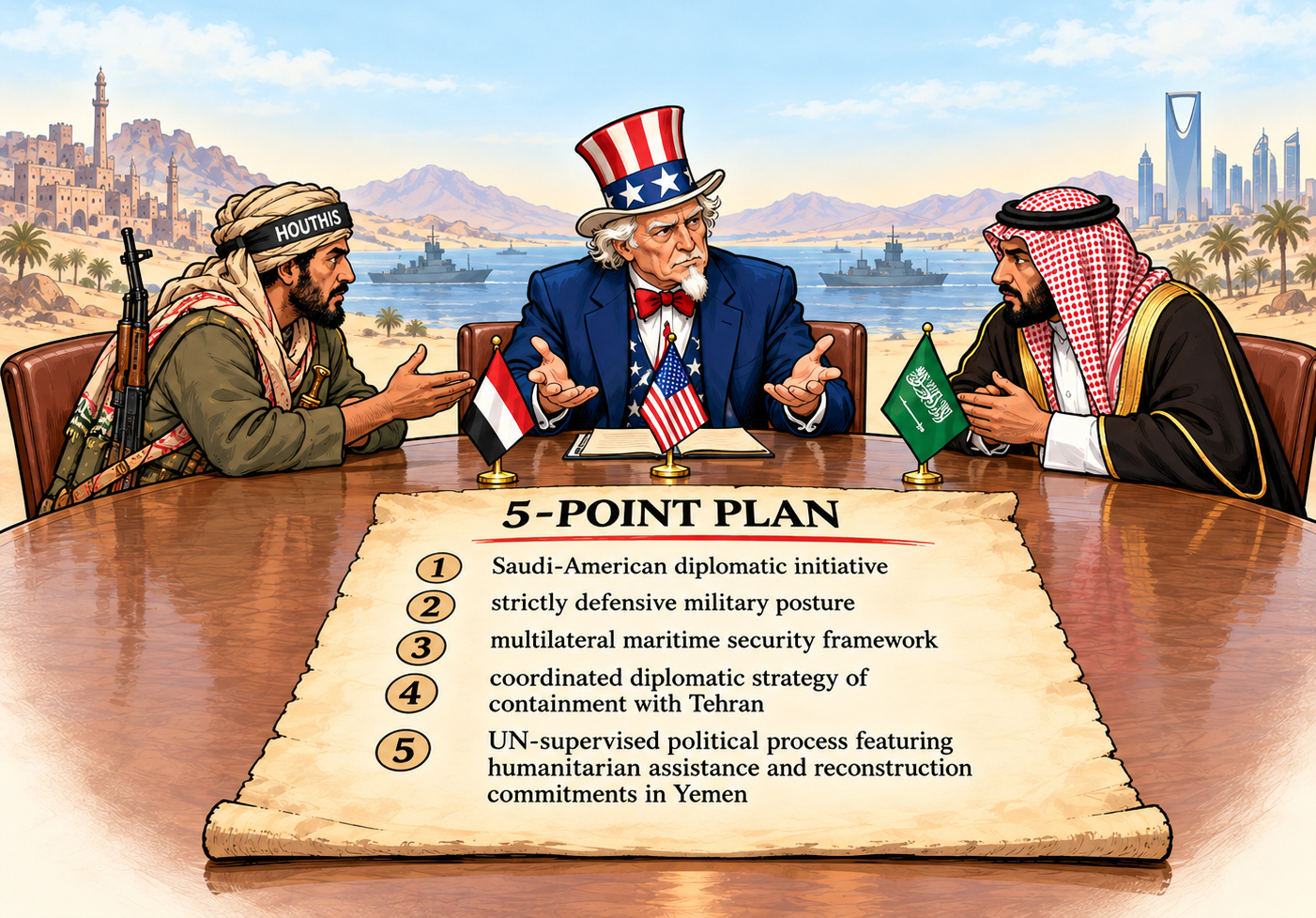
Rather than entering an expanded Saudi-Houthi military confrontation, the Trump administration should adopt a five-part regional security strategy:
First, Washington should adopt a multilateral posture and establish a Saudi-American diplomatic initiative. Oman and the United Nations would be the primary diplomatic partners directing their efforts to revive direct negotiations between Riyadh and the Houthi leadership. The objective should be a verifiable ceasefire, guarantees against cross-border missile and drone attacks, and a framework for a durable Yemeni political settlement. Saudi Arabia remains to be the party to convince as it has continually signalled it is “too early” to engage in negotiations with the Houthis. After more than a dozen years of military conflict that has yet to yield desirable results, with Houthis continuing to strike inside Saudi Arabia and disrupting worldwide shipping, diplomacy by direct negotiations seems not only prudent, but urgent.
Second, the United States should maintain a strictly defensive military posture in the Red Sea and Gulf of Aden. Aside from the ongoing freedom of navigation challenges posed by the Israel-US war in Iran, American naval assets should project a security prone but neutral stance in the region as a policy position. Promoting freedom of navigation, escorting vulnerable commercial shipping where necessary and intercepting threats while maintaining a robust capability to deter attacks against American personnel and regional partners should be the watchword. Contrary to repeating an offensive blockade such as operateds now in the Strait of Hormuz, the US should avoid defensive operations becoming a pretext for an open-ended offensive campaign. A defensive posture must be operated within the context of prioritising diplmatic efforts at finding a solution.
Third, Washington should build a genuinely multilateral maritime security framework in the region. Engagement with Saudi Arabia, the United Arab Emirates, Oman and other regional partners would create a bulwark against weaponising geography and arms to impede freedom and navigation as a financial weapon. The multilateral maritime security framework could proportionately distribute the financial and operational burden, strengthen regional ownership of maritime security and reduce the perception that Washington is engaged in a renewal of colonialism by unilaterally imposing its military and foreign policy priorities on the region .
Fourth, the administration should pursue a coordinated diplomatic strategy of containment with Tehran. Employing international sanctions, diplomatic engagement and clear consequences to discourage the transfer of advanced weapons systems and military technology to the Houthis should underpin these efforts. The overarching objective of this initiative should not be to induce regime change or punish Iran. Focus should be directed at encouraging Iran to constrain its military assistance to the Houthis without providing Tehran with an incentive to expand the confrontation.
Finally, the United States should support a UN-supervised political process featuring humanitarian assistance and reconstruction commitments in Yemen. Aleviating some of the underlying political and economic fragmentation and pressures in Yemen could reasonably reduce the causes that drive internal divisions and conflict. Resolve that Yemen’s future should not be determined exclusively through negotiations between Riyadh and Tehran should be a starting point for empowring Yemen to assert self determination and ceasing to be a pawn in regional power play.Any durable settlement must contemplate that the Houthis cannot simply be eliminated militarily.
A considered, strategic approach to solving immediate problems and creating the possibility for regional peace, stabilisation and normality would preserve American deterrence goals, protect international commerce, reinforce Saudi Arabian security and limit opportunities for Iranian escalation. All of this can and should be pursued and achieved while avoiding the strategic and humanitarian costs of another American military intervention that further destabilising the region and sends weaker parties seeking the patronage of external State interests.
The measure of American leadership should not be whether it can “win” another military campaign but use its wealth, prestige and claimed exceptionalism to bring peace and prosperity to a region for which it bares significant responsibility for its current circumstances.