



by Miceál O’Hurley

DUBLIN ― Successive Irish governments have boasted about Ireland’s economic success and wealth accumulation. Former Tánaiste Leo Varadkar vaunted how Ireland consistently ranks among the world’s top 10 or 20 countries in terms of wealth and living standards. Former Minister Paschal Donohoe and now Managing Director of the World Bank Group described Ireland as one of the European Union’s wealthiest Member States. As Europe has fallen into widespread riots and protests, primarily, over economic woes, an Taoiseach Micheál Martin has repeatedly highlighted the resilience of the Irish economy, record employment and the strength of public finances.
These are not the claims of an economically struggling nation. They are acknowledgements of extraordinary national economic achievement. Ireland is commonly ranked third globally in nominal GDP per capita trailing slightly behind small states like Luxembourg and Lichtenstein.
Still, prosperity measured in national metrics does not automatically translate into financial security at the household level. Many Irish people struggle with growing financial insecurity arising from a 27-year housing crisis, some of the highest per capita consumer costs in Europe and the nation’s economic sensitivity to international shocks caused by the war in Iran and other factors beyond domestic control.
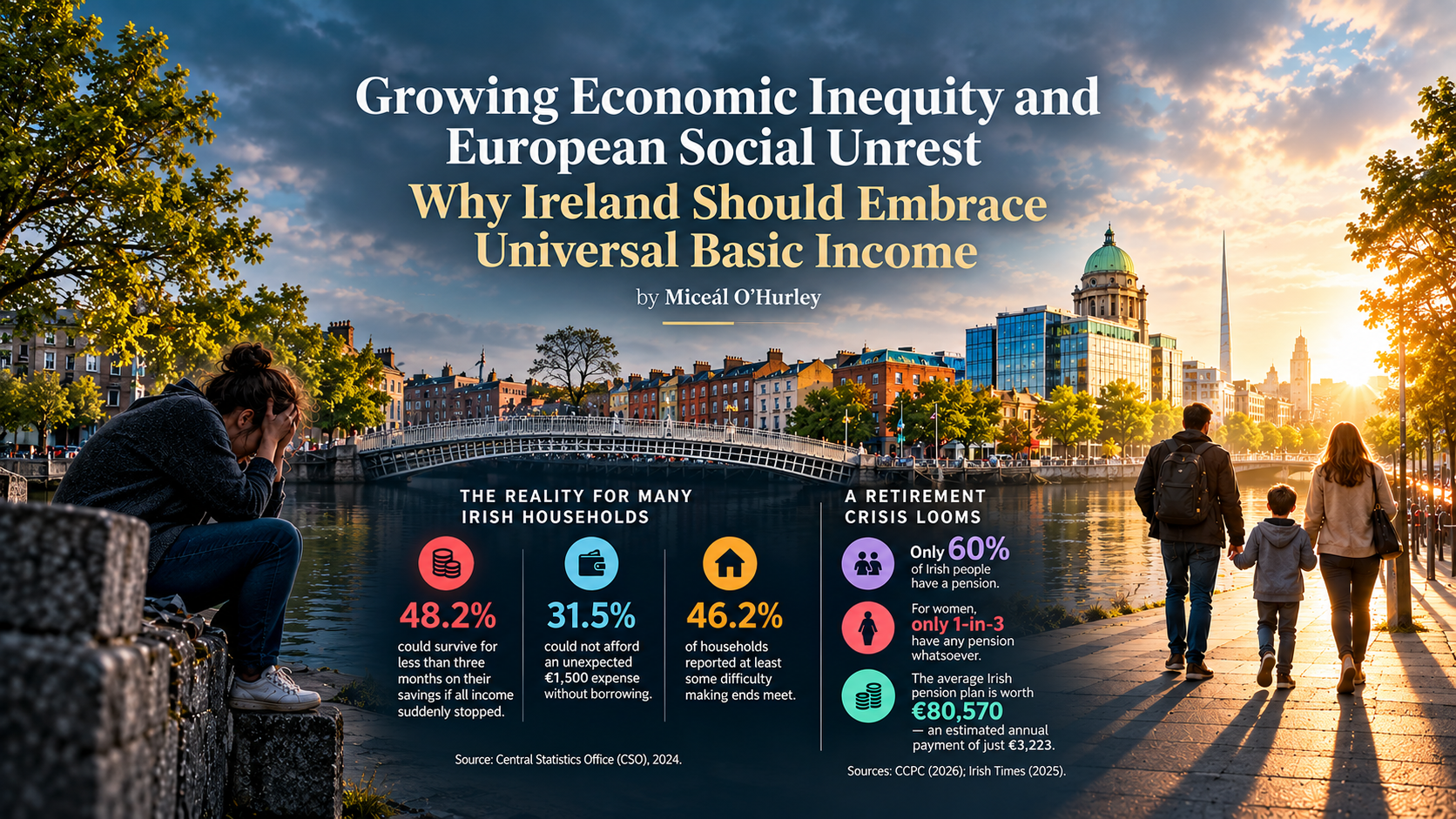
Despite political claims of wealth, almost always measured in terms unrelated to the common worker and citizen, financial insecurity is at a crisis point in Ireland. Consider the following 2004 statistics from the Irish Government’s Central Statistic Office:
- 2% of Irish households could survive for less than three months on their savings if all income suddenly stopped.
- 5% could not afford an unexpected €1,500 expense without borrowing.
- 2% of households reported at least some difficulty making ends meet.
The axiom, “While the present shouts, the future whispers” seems to be far from the thoughts of those touting Ireland’s wealth standing.
The nation’s retirement crisis provides another compelling illustration of the gap between national prosperity and individual financial security. According to the Competition and Consumer Protection Commission’s September 2026 pension research, only 2-in-5 people with a pension are confident that it will provide them with a good standard of living in retirement. Shocking, only 60% of Irish people have a pension. For women, only 1-in-3 have any pension whatsoever. As reported by the Irish Times in 2025, the average Irish pension plan is valued at only €80,570. With an estimated annual payment upon retirement, not indexed to inflation, of only €3,223 the difficulties of today look even more bleak in the future.
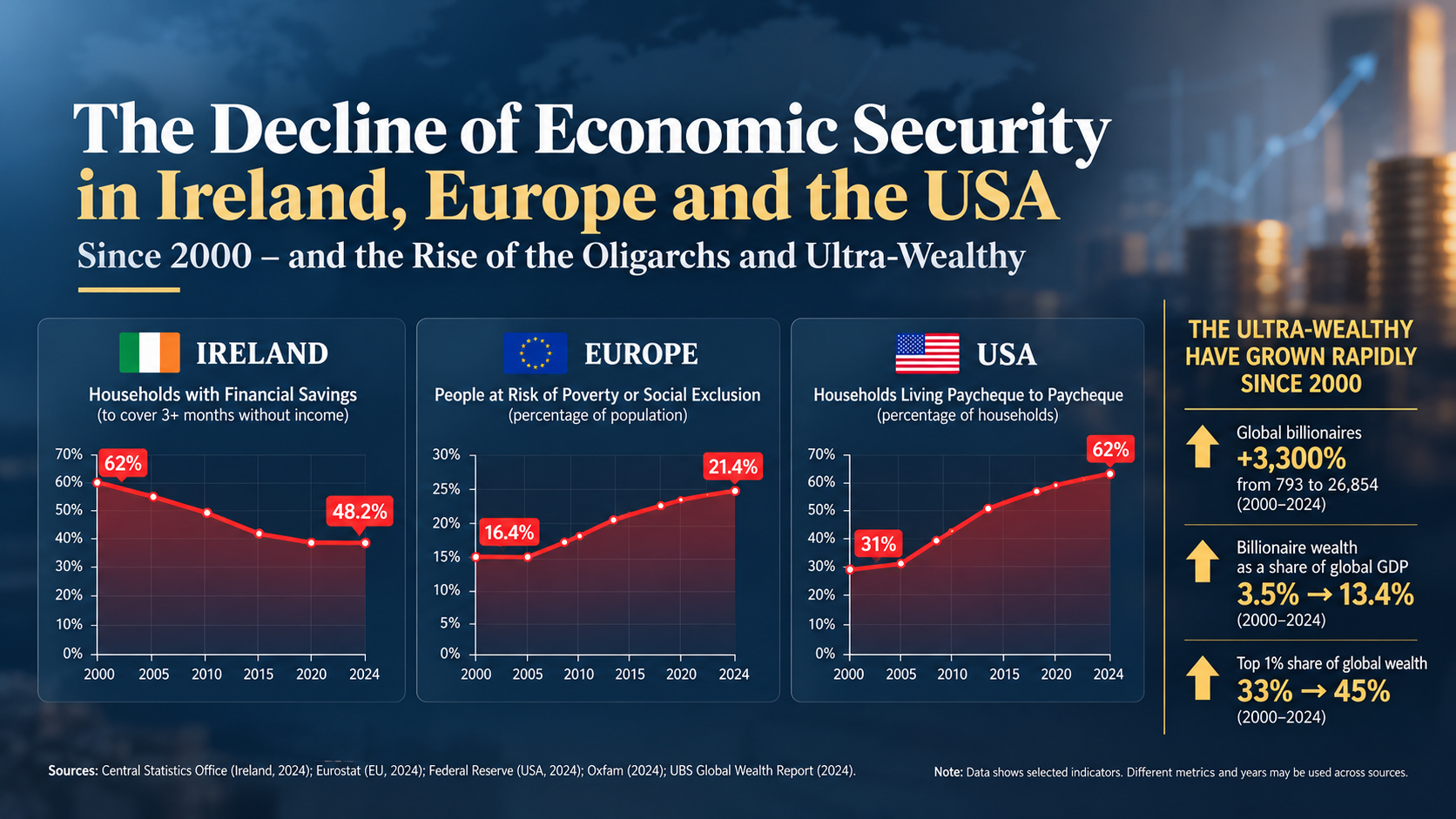 Messaging about Irish economic success in context raise fundamental questions about the sustainability of the very social model upon which modern Ireland, and much of Europe, is built. The increasingly expectation that the public must provide for their own retirement, despite substantial numbers lacking the disposable income to save adequately, smacks of political insensitivity and indifference to today’s economic realities. The time has come for Ireland and other European states to do more than pay lip service to the concept of a Universal Basic Income (UBI). The growing economic inequalities that have thrust much of Europe into violent riots, social unrest, youth protests, and industrial action demands a real response. Ireland could take a positive step forward in rectifying social inequality, economic disparity and lift the nation from the crushing cycle of broken promises for young people by providing for a guaranteed financial foundation throughout working life and retirement, alongside rather than instead of appropriate pension provision.
The alternative is more political boasts about Ireland’s wealth status made by ignoring the glaring reality that almost half of Irish households are in the cruel grip of economic insecurity. For many, every political speech in which the elected political class invokes Irish wealth as a justification for their policies and re-electability sounds increasing tone deaf as if they were Marie Antoinette asking why people simply do not eat cake during a bread shortage. While law and order and appeals to respect institutions may quell the worst unrest on Irish streets it doesn’t begin to address the fundamentally broken social and economic model that tears at the hearts and minds of a nation of people who are every more fearful they have no future.
Ireland has an obligation to transform the power of its much-claimed wealth into an economic tide that lifts all boats. Ireland’s national ambition should be to ensure that prosperity extends to benefits that are more widely shared by all. UBI offers an opportunity to turn economic success into a tangible social dividend.
Ireland’s social and economic models can measurably be shown to have failed almost half of its population. Housing affordability, rising living costs, precarious employment, technological disruption, and widening inequalities raise an important question, “Should Ireland continue relying almost exclusively on traditional employment-based welfare, or embrace a more ambitious model of economic security”?
Abandoning the industrial-age economic model to a modern, proven model which includes UBI deserves earnest consideration.
UBI is a regular, unconditional cash payment made to individuals, irrespective of employment status or income. Its purpose is not to replace economic ambition or discourage work, but to establish a minimum financial foundation from which citizens can participate more freely and productively in society.
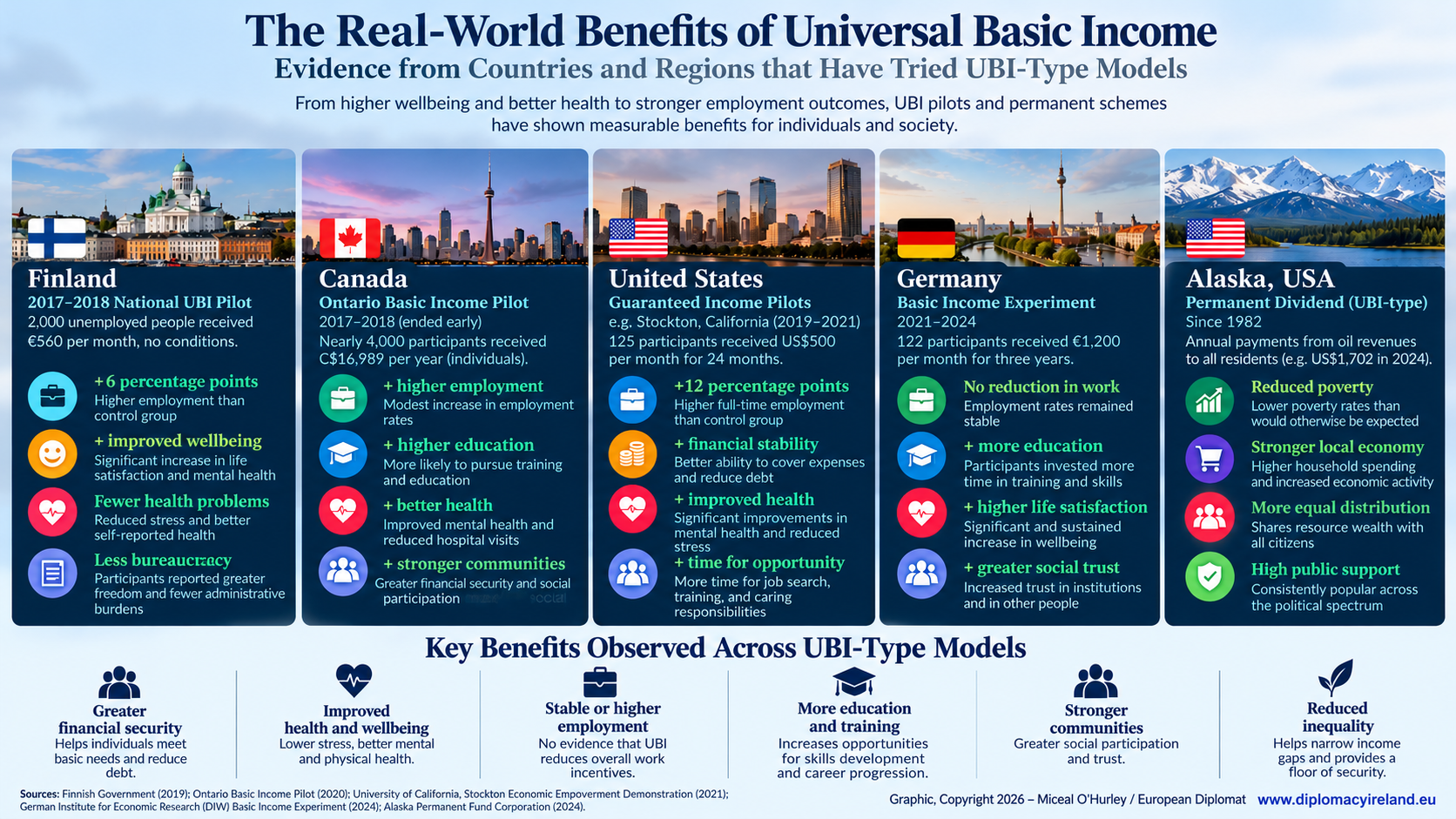
International experience offers valuable lessons to which Ireland should take heed. Finland’s 2017–2018 basic income experiment, involving 2,000 unemployed participants, found improvements in perceived wellbeing, financial security, and confidence, without producing a substantial employment disincentive. The experiment was limited in scope but challenged the assumption that unconditional payments necessarily undermine the incentive to work.
Even America’s unbridled capitalism offers instructive examples of UBI-like programmes working well. Alaska’s Permanent Fund Dividend, financed through investment returns from the state’s oil wealth, distributes annual payments to residents. Research by Damon Jones and Ioana Marinescu, published in the American Economic Journal: Economic Policy (2022), found that the dividend did not significantly reduce overall employment, although it increased part-time work.
These experiences suggest that financial security and economic participation need not be competing objectives.
Ireland’s own experience is particularly compelling. The Government’s Basic Income for the Arts pilot, evaluated by Alma Economics, generated more than €100 million in estimated social and economic benefits between 2021 and 2025. Its cost-benefit analysis found that every €1 invested generated €1.39 in social value. The programme also contributed to improved psychological wellbeing, improved creative-sector earnings and reduced reliance on social protection. This is important evidence that unconditional income support can generate benefits beyond the immediate financial payment, chief amongst them are enhanced productivity, improved quality of life, better health outcomes and enhanced sustainable development goal achievement.
Opponents of UBI complain it is not the uncomplicated panacea it claims to be. The Organisation for Economic Co-operation and Development (OECD), in its 2018 working paper Mechanics of Replacing Benefits Systems with a Basic Income, warned that a meaningful universal payment could require substantial tax increases and reductions in existing benefits. OECD modelling also cautioned that replacing targeted welfare payments with a uniform benefit could exacerbate poverty among some vulnerable households.
The International Monetary Fund has similarly identified the substantial fiscal costs of universal payments, alongside concerns about inflationary pressures where additional spending encounters constrained housing, energy, or other essential supplies. The central challenge is therefore not simply whether Ireland can afford UBI, but how it could finance and structure it without undermining essential public services or existing disability, housing and pension supports.
 Continuing to embrace the prevailing industrial-age social and economic model that fails almost half of the population in the technology age almost invites social and economic strife. Blanket “capitalist condemenation” from an investor-oligarch class should not be used as a bulwark against change. Ireland should approach implementation pragmatically―but do so without dealy. A process model of commissioning an independent national economic assessment, developing a progressive taxation and funding model, and introducing a phased but near-term, independently evaluated programme.
Any transition should target the protection of existing welfare entitlements for the vulnerable should be protected during the transition. Attention to households whose needs exceed a standard payment should be given. Surely, such a system could not prove any more of a disincentive to work than the current one that largely encourages those in receipt of social welfare payments from improving income generation because the trade-off of medical cards and other special payments become a disincentive to economic security.
Free market capitalists continue to cast the UBI as a dangerous economic model while ignoring the social and economic ills the antiquated models now in play produce. The UBI is not a challenge to capitalism but rather a decision about the kind of economy and society Ireland wishes to build where inequality and diminished futures now abound. As artificial intelligence, automation, and changing employment patterns are reshaping the labour market daily, tying financial security exclusively to archaic employment models becomes increasingly difficult to justify.
The very wealth politicians claim Ireland possesses shows that it has the fiscal capacity, institutional experience, and economic evidence to lead this debate. UBI should no longer be dismissed as an idealistic experiment or as an enemy for performance-based capitalism. Intelligently designed, UBI promises to become an instrument of economic resilience, social cohesion, and human dignity.
The question is no longer whether Ireland should investigate UBI, but whether it can afford not to. This autumn’s riots in Albania, Belgium, France, Italy, Spain and demonstrations elsewhere across Europe are harbingers of what is likely to be repeated and grown as AI and other forces continue to reshape the antiquarian social and economic models that produce polarised wealth classes and deprive our youth of any semblance of a promising future, even if they embrace the old adage of, “Work hard and you will prosper”.