



by Miceál O’Hurley

DUBLIN ― Over the last 80-years, Europe’s bold experiment in democracy, the EU, has worked wonders to forge stable institutions and ameliorate the underlying causes and effects that led to centuries of inter-state conflict. Its forays into social engineering and progress have, however, failed to alleviate the widespread dissatisfaction with foundational quality of life issues that span domestic economic policies. The confluence of the unintended outcomes of public policy and rapidly shifting demographics and economic conditions now threaten what security the EU has engineered. The growing turbulence from core societal issues ranging from immigration to education and economic opportunities have led to wide-scale demonstrations and urban riots recently spanning the continent.
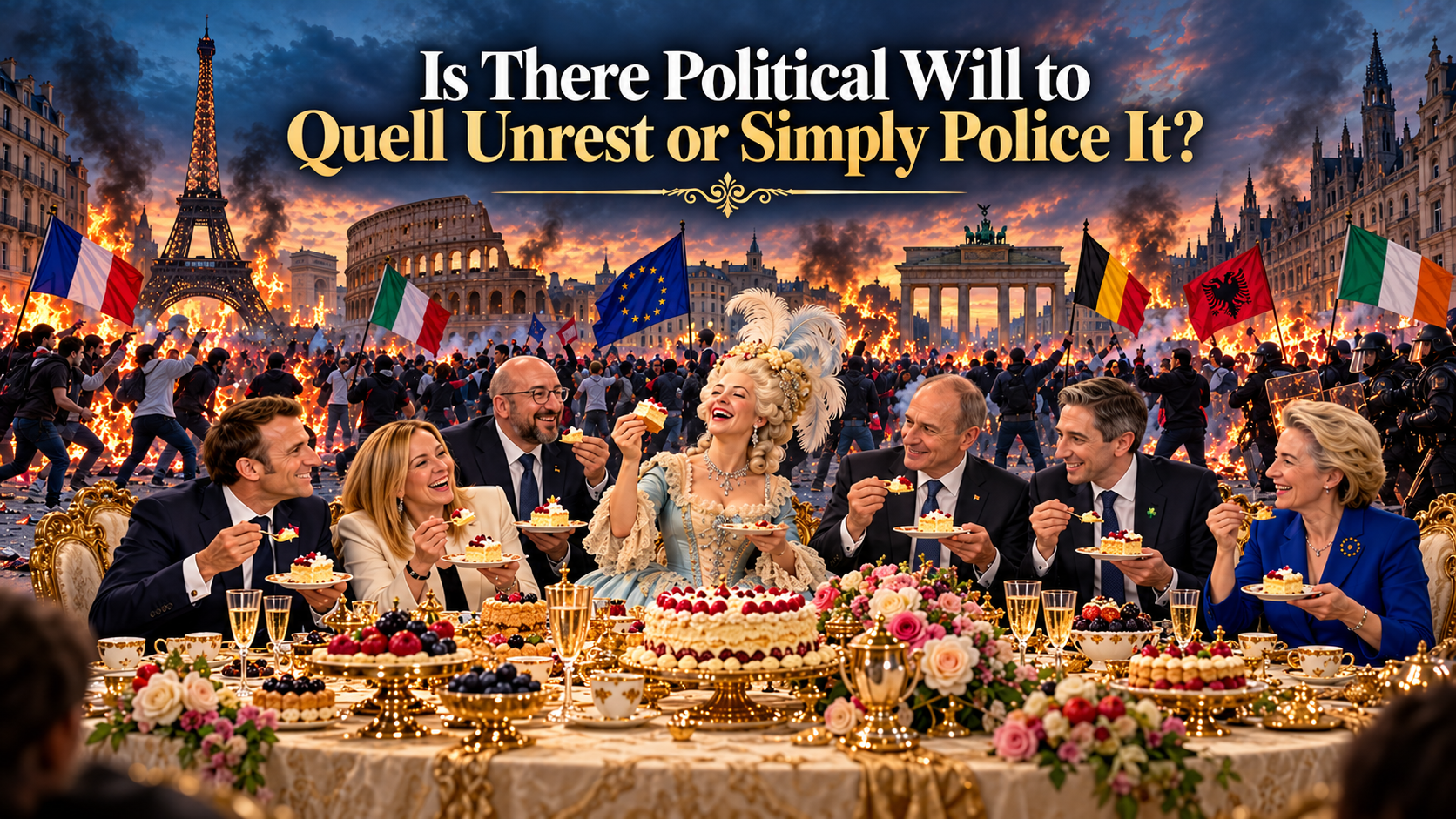
Since September, growing unrest has resulted in violent confrontations between protesters and police. While the rioting and protests in France have dominated the news, a growing proportion of the continent is experiencing a visible erosion of social cohesion. Although the circumstances differ between countries, the underlying questions are increasingly common: “Why are so many European societies becoming so dissatisfied with the political, economic and social order”? And, “Do governments have the political will to reverse this trend”?
Economic insecurity tops the poll for most protesters. Rising costs of living, housing shortages, stagnant wages, and the widening perception that economic opportunity is increasingly inaccessible have generated palpable frustration across Europe. Young people complain of their earning capacity lagging behind their parent’s generation, employment stability is rapidly dissipating, retirement age is being pushed off into the distance making for a bleak outlook for ever enjoying a post-working life nearly unimaginable. The cost of education to rise above entry-level employment wage earning is disproportionate to the rewards and AI threatens to make even the most highly educated redundant to technology in ways impossible to project.
Research from UCL Policy Lab, Citizens UK and More in Common identified social disconnection, deprivation and failures of integration as important contributors to the similar 2024 British riots. Subsequent analysis by Eurofound in 2025 also identified economic instability as a major driver of political polarisation. The current wave of riots across Europe, which continues to grow, arises from the failure to take what research concluded were threats to a repetition of unrest in the absence of addressing economic disparity.
For many Europeans, the traditional promise that hard work will deliver a better standard of living appears is daily experienced by Europeans as being divorced from reality. Economic disparity, once the watchword of far left, fringe socialist parties is now a driving worry for all Europeans. As an increasing number of citizens believe that political and economic institutions serve established interests rather than ordinary people, disillusionment the result is dissolution being transformed into violent confrontation.
Immigration and integration have, as they have always been during periods of economic shifts, become increasingly contentious political issues. Significant numbers of Millennials and Gen-X Europeans blame current woes on the Baby Boomer largess, environmental recklessness and economic carelessness that threatens their future. The massive deficit spending and commercial abandon that led to repeated debt cycles, market instability, banking collapses, and insurance industry collapses that racked the world economy have combined to leave younger Europeans with a bleak future. Looking at the rise of oligarchs across the state and political, tech and infrastructure and Russian tycoons and post-Soviet industrialists who have accumulated massive wealth, a growing number of Europeans believe they are indentured servants to sustaining others’ wealth creation and sustainment at their own expense.
Rapid demographic change, pressure on public services, inadequate integration policies and anxieties about national identity have ploughed fertile ground for political polarisation. These concerns are sometimes exploited by extremist movements, which transform legitimate public policy debates into campaigns of hostility against minority communities. Interest groups and even international actors have enjoyed some success in coopting the unrest for parochial benefit. In the US, President Donald Trump has joined far-right European voices like those of AfD leader Alice Weidel in affixing European social unrest to immigration policies and crime. Talking heads on Russian media seem fixated on blaming liberal Western values for social decay. The causes underlying the protests and violence are, however, not so simple and are complex and interconnected.
Equally dangerous is the temptation by liberal, democratic governments to dismiss public concerns about immigration as inherently xenophobic and the product of ignorance. The rioting that has erupted on the streets of Albania, Belgium, France, Italy, Spain and elsewhere across Europe governments can only ignore widespread dissatisfaction at their own political risk and forfeiture of social stability. States like Ireland have experienced large scale protests but have so far escaped the violent confrontations between police, security forces, and citizens on the streets. How long that lasts remains uncertain.
The European political establishment can no longer continue to dismiss the electorate’s significant decline of confidence in political leadership. Across Europe, rising questions about whether elected representatives understand the everyday circumstances of the average person. Perceived corruption, political privilege, broken electoral advantage may achieve short-term political stability, but they risk weakening the democratic institutions upon which their authority ultimately depends.
At present, more than 300,000 Irish public servants are engaged in industrial action, including intermittent strikes, demanding higher wages. This represents the largest public sector industrial action in over 20-years. While Irish people are generally supportive of increasing wages the public servants demand threaten to increase the burden on the working class and unemployed at a time of growing economic insecurity. The industrial action for higher compensation for civil servants who already earn on average one-third more than the Irish median income earner and more than twice the minimum wage worker could tip Ireland’s protests into the type of riots plaguing the European continent.
The general and common wage Irish public servant earns on average €62,950 per year. Meanwhile, a minimum-wage worker in Ireland earns only €29,432 per year and the non-public servant, median income earned by an Irish person is €44,816 per year. For the young Irish person facing limited job opportunities with most at the lower end of workforce earnings, the significant disparity between their earnings and those of public servants undergirds their social alienation and frustration. This comes at a time of a 27-year housing crisis where home ownership has become a fantasy while the unchecked, rising costs of living are transforming dissatisfaction into activism marked by rage. Riots remain squarely on the horizon.
Within the knowledge that inevitable pay increases for the public sector are government’s quickest and easiest way to regain the favour of a large sector of the workforce and an active voting bloc is the realisation that in doing so lawmakers will award themselves pay rises. Section 8 of the Ministerial and Parliamentary Offices Act 1938, as amended mandates that Members of Dáil Éireann (TDs) are automatically entitled to higher renumeration indexed to public sector pay increases. Most Irish people, and certainly the young most activated by issues of inequity, feel government has stacked-the-deck against them with institutional and structural advantages for political, techno, investor class, commercial and industrial oligarchs. The inequities of it all have now come home to roost across Europe and are likely to extend into Ireland.
Interpreting Europe’s present difficulties as the inevitable decline and collapse of liberal, Western democracy and free market capitalism would be an error. Rather, they collectively serve as a warning that democratic institutions cannot survive on constitutional guarantees alone. Public confidence, real economic opportunity, social responsibility, and credible leadership remain requisites for functional governance and the stability of the social compact that makes for tranquillity.
The challenge facing Europe is therefore not simply how to restore order after a riot, but how to create more just societies in which fewer people feel that taking to the streets in violence is the only remaining reaction to an intolerable situation. The rioting across Europe is likely to spread as police cordons and curfews do nothing to address the underlying cause of dissatisfaction. Stability cannot be imposed indefinitely through policing and blaming unrest on miscreants. Societal bliss must be earned through fairness, competent governance and a renewed social contract between governments and the people they serve.
Populist political leaders like Donald Trump have spent inordinate amount of energy diminishing trust in the very institutions that provide for political stability and, at times, dismantled the institutions altogether. Germany’s AfD, transactional populists like Viktor Orban, Robert Fico and Rumen Radev have also all struck at the heart of institutional trust as a means of gathering support for their cult of personal political power. Institutional decline and public confidence have proven both fuel and accelerants for dangerous public discord as Europe’s history, past and present, records.
Violent unrest in Europe should serve as a harbinger of caution that in times of crisis, public confidence in institutions sometimes stands as the last barrier standing between stability and chaos.