



by Miceál O’Hurley

WASHINGTON, D.C. ― Friday’s White House announcement of an unexpected oil deal with Russian President Vladimir Putin and the US Treasury Department’s sanctions against the International Criminal Court (ICC) made headlines. They should. They are inextricably connected.
US President Donald Trump ordered US Treasury Secretary Scott Bessent to immediately provide trade permits to Russia to sell significant amounts of oil to the US and on the world market contrary to US and international sanctions regimes. Standing on the South Lawn of the White House, Trump personally thanked Putin, adding:
I have just concluded a highly successful discussion with President Vladimir Putin, of Russia, wherein it was agreed that Russia will immediately supply over 300,000 Tons of Diesel Fuel to the American and Global Marketplace, another 500,000 Tons during the month of November, and 1,000,000 Tons immediately thereafter.
There is strong suspicion that Trump and Putin may have struck a secret oil deal prior to Friday’s announcement. Even while campaigning for incumbent US Senator Darline Graham who pushed to have the Lindsey O. Graham Sanctioning Russia and Iran Act of 2026 passed in honour of her brother, Trump seems to have been conspiring with Putin to skirt these sanctions.
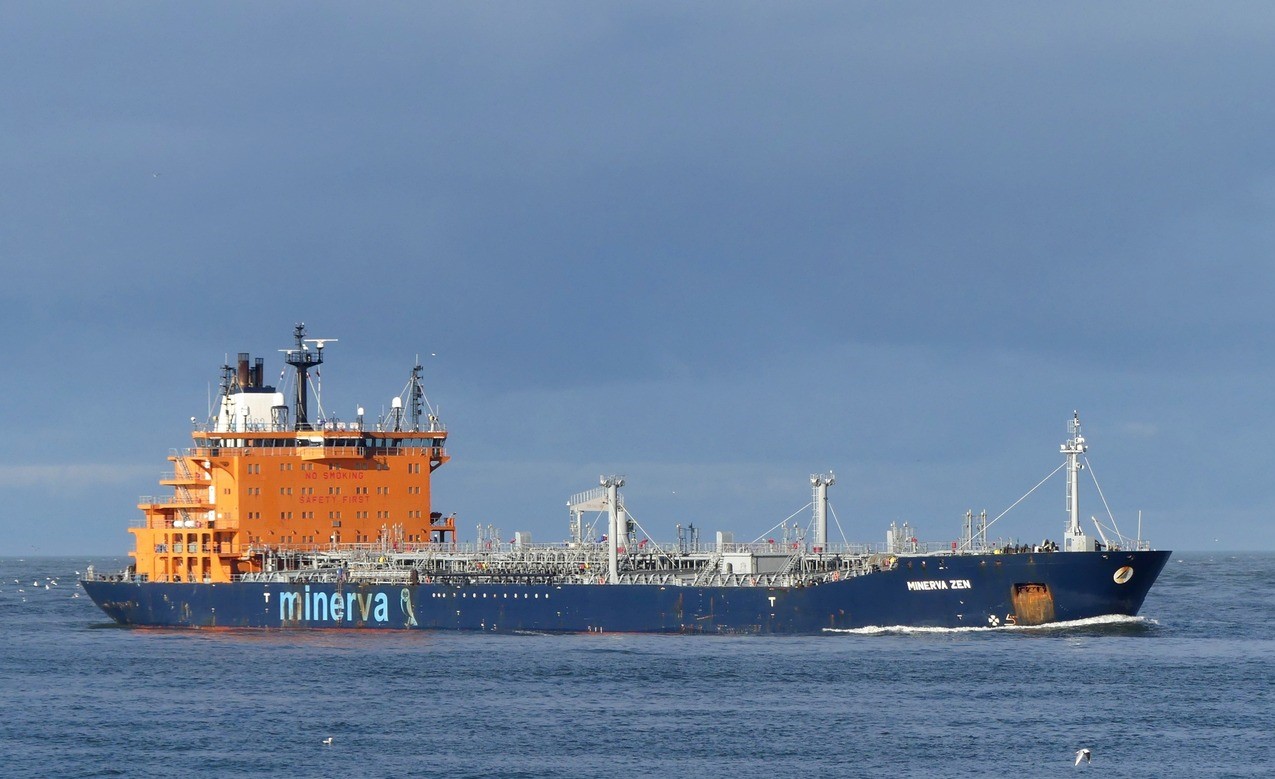 The oil tanker Minerva Zen left St. Petersburg on September 22nd bound for a US refinery. It is expected to make port in Wilmington, North Carolina within hours, just over 1-day after the Russial oil deal was announced and contrary to its now abandoned manifest filed in September. The manifest of the Minerva Zen, a Greek flagged tanker, shows she carries some 300,000 barrels of Russian diesel worth $60 million. An open source shipping information databse maintained by the Black Sea News shows the Russian oil tanker is part of Russia’s “shadow fleet” used to defy sanction regimes.
An internal desk analysis by The European Diplomat indicates that the Trump-Putin oil deal will primarily have a speculative impact on world markets. Given Ukraine’s now long-range strike capability Russian oil ports are vulnerable to strikes. Last night, Ukrainian drones and missiles hit a key Russian oil refinery and loading terminal at Novoshakhtinsk. Serious questions remain concerning Russia’s ability to deliver oil in quantities substantial enough to effect world markets. Even at the rates announced by Trump, Russian oil sales could at best represent only 1%-3% of global supply. While seemingly inconsequential to worldwide demand and downward price pressure these sales could still net Russia and estimated $5.1 billion in cash to fund their war machine and enrich Russian oligarchs who control key economic sectors.
While the Trump-Putin oil deal dominated Friday’s news cycle, the Trump administration concurrently sanctioned the entire International Criminal Court. In making the announcement, US Secretary of State Marco Rubio said:
“We will ban transactions with this rogue court, cutting off their resources and crippling its ability to operate against us”.
The US has long opposed the ICC attempting to hold US military personnel accountable in international law. Congress enacted the American Servicemembers’ Protection Act in 2002 to shield its military personnel for becoming subject to the jurisdiction of the Court. The Trump administration has operated on the premise that hampering the ICC is preferable to observing the norms and objectives of international law.
Trump’s motivation for the oil deal has proved troubling for both Democrats and Rupublicans alike. Posting on X, Republican Congressman Brian Fitzpatrick wrote, “We will be introducing bipartisan legislation to block any and all purchases of Russian oil. It will be forced to the Floor via discharge and it will pass overwhelmingly”. Congressman Don Bacon (Republican-Nebraska) has agreed to co-sponsor the bill. A discharge petition can force a House vote without approval from the relevant committee or House leadership if it secures 218 signatures. Congressman Michael McCaul (Republican-Texas), the former chairman of the House Foreign Affairs Committee, saliently summed-up the the Trump-Putin oil deal:
“[The Trump-Putin oil deal will] fund the Kremlin's war machine―emboldening more violence and destruction”.
Statements from Trump’s own allies like Fitzpatrick, Bacon and McCaul will no doubt form evidence Trump should be and is aware of how the funds from his oil deal with Putin will be used. Context is also important. While Trump has vociferously argued, “Higher gas prices are a small price to pay to deny Iran a nuclear programme” he has taken a contrary view that higher prices are an unacceptable a price to pay if they keep Russia from funding its war and war crimes in Ukraine. Leaks from White House insiders have claimed the Trump decided on agreeing to the Putin proposed oil deal in retaliation for Ukrainian President Zelenskii’s refusal to stop attacking the Russian oil refineries that fund Russia’s war in Ukraine.
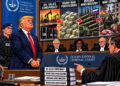
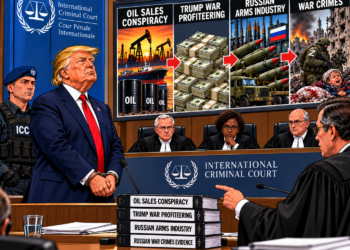
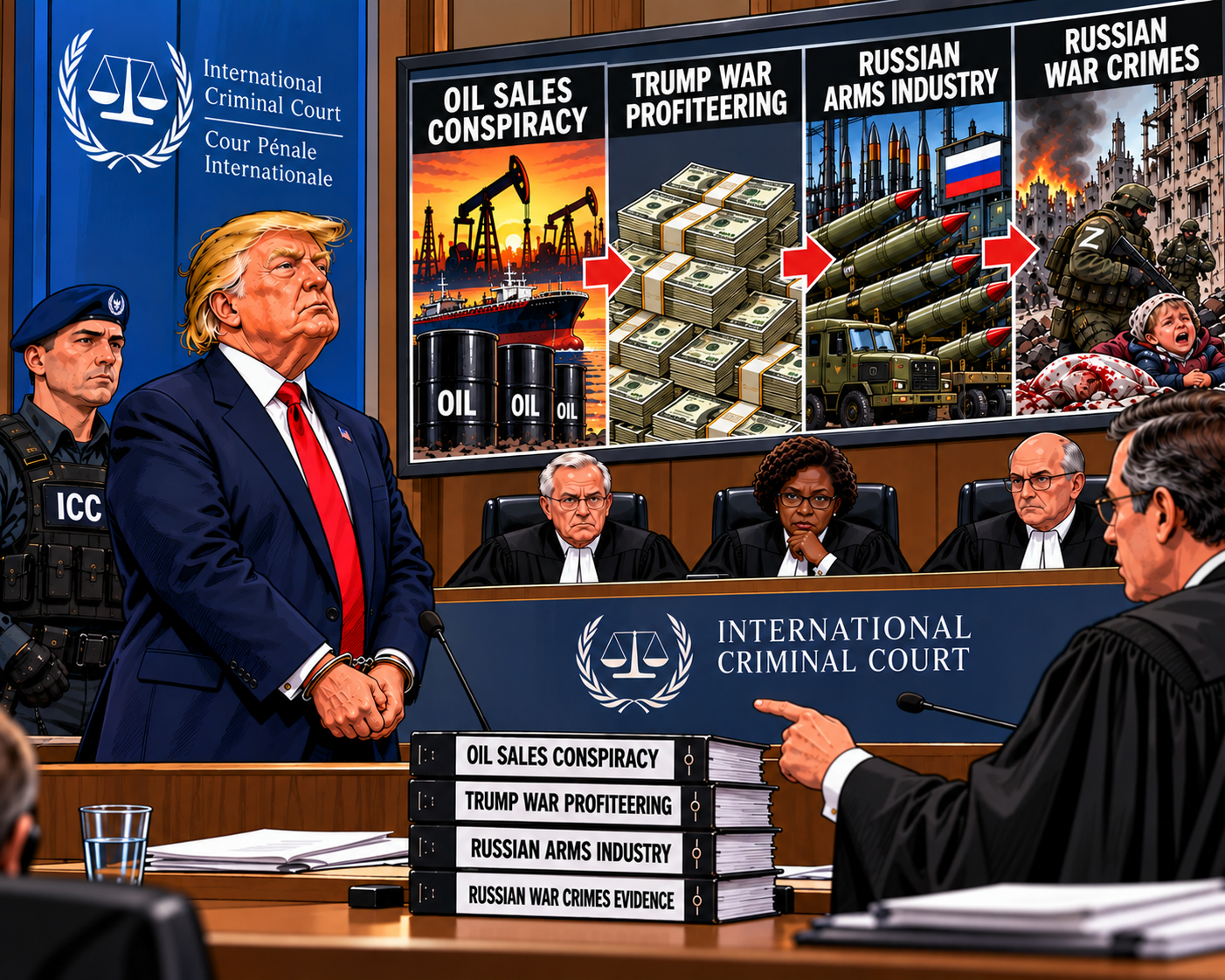
Can Trump’s policy decision result in his indictment before the ICC? It could prove difficult but not unimaginable. The greater question remains will it encourage good governance and legal compliance? The reality of his announcing the Trump-Putin oil deal portends not.
While the US is not a signatory to the Rome Statute of the International Criminal Court it is still subject to international law and the Hague Court’s jurisdiction. Trump should have reason to be concerned that his oil deal with Russia could see him indicted by judges of the Pre-Trial Division of the ICC. Friday’s sanctioning of these judges was typical of Trump’s bully-boy, muscular messaging by which he hopes to deter threats to his person and fortune. Trump has also used the threat of litigation to try to ward off unwanted scrutiny. At present, Trump has lodged 6 lawsuits against the media, seeking billions of dollars in compensatory and punitive damages. Trump’s tendancy towards aggressive action seeks to shift the balance of power in the hope the cost of defending these actions will cause news organisations to refrain from publishing unflattering articles or revalatory details concerning what is variously alleged to be criminal conduct on his part.
Trump’s lawyers and the White House Council have no doubt informed Trump that international law does not generally make a political leader criminally responsible merely because his commercial or foreign policy decisions benefit a state committing war crimes. And, Russia is committing war crimes. From rapes, torture, mass murder, extrajudicial executions to the targeting of civilian housing and critical infrastructure vital to sustaining human life, Russia has waged a cruel and aggressive war in Ukraine. A reocurring hallmark of its military operations and public policy is Russian indifference to international law and the norms of humanity. Time will tell if these acts keep Trump awake at night and have his lawyers burning the midnight oil preparing to defend him against indictments that will undoubtedly be petitioned from the ICC.
Article 25(3)(c) of the Rome Statute provides for individual criminal responsibility where a person acts to provide resources for the commission of war crimes. As the US Congress, the Biden Administration and even Trump in his first Administration, imposed sanctions on both Russia and Putin personally to deprive them of the resources to wage war and remain obdurate in the commission of war crimes the Trump-Putin oil deal seems inexplicable. The decision to now provide Russia with cash resources which will be used to fund the continuation of the war and the notorious criminality of Russia’s illegal occupation in Ukraine may prove incriminating and impossible for Trump to escape.
International Law provides mechanisms for prosecuting individuals who knowingly facilitate, assist or contribute to the commission of international crimes. Article 27 of the Rome Statute expressly provides that official capacity, including being a Head of State or Government, does not exempt an individual from criminal responsibility before the ICC. The long-standing US position not to recognise the ICC does not provide absolute protection against the Court exercising jurisdiction of an American.
The US could also face a State indictment under Article 16 for knowingly aiding or assisting Russia in committing an internationally wrongful act in Ukraine. As Ukraine ratified the Rome Treaty on 1 January 2025, and accepted its jurisdiction over war crimes committed since the Russian full-scale invasion in 2022, given Trump’s knowledge and US involvement in Ukraine an irrefutable nexus to establish ICC jurisdiction is indelible. Still, developing a case against Trump, the necessity of engaging in non-cooperative discovery and marshalling the evidence required to indict Trump will not be easy given the high standards of the ICC.
There is also the issue of war profiteering. According to Democratic House Oversight Committee staff reports, “Trump and his family are using the White House to make billions, we are tracking every cent. As of January 2026, our Committee’s analysis shows that these schemes have contributed to an estimated $2.25 billion in realized profits for Trump from foreign payments, corrupt oligarchs, and others”.
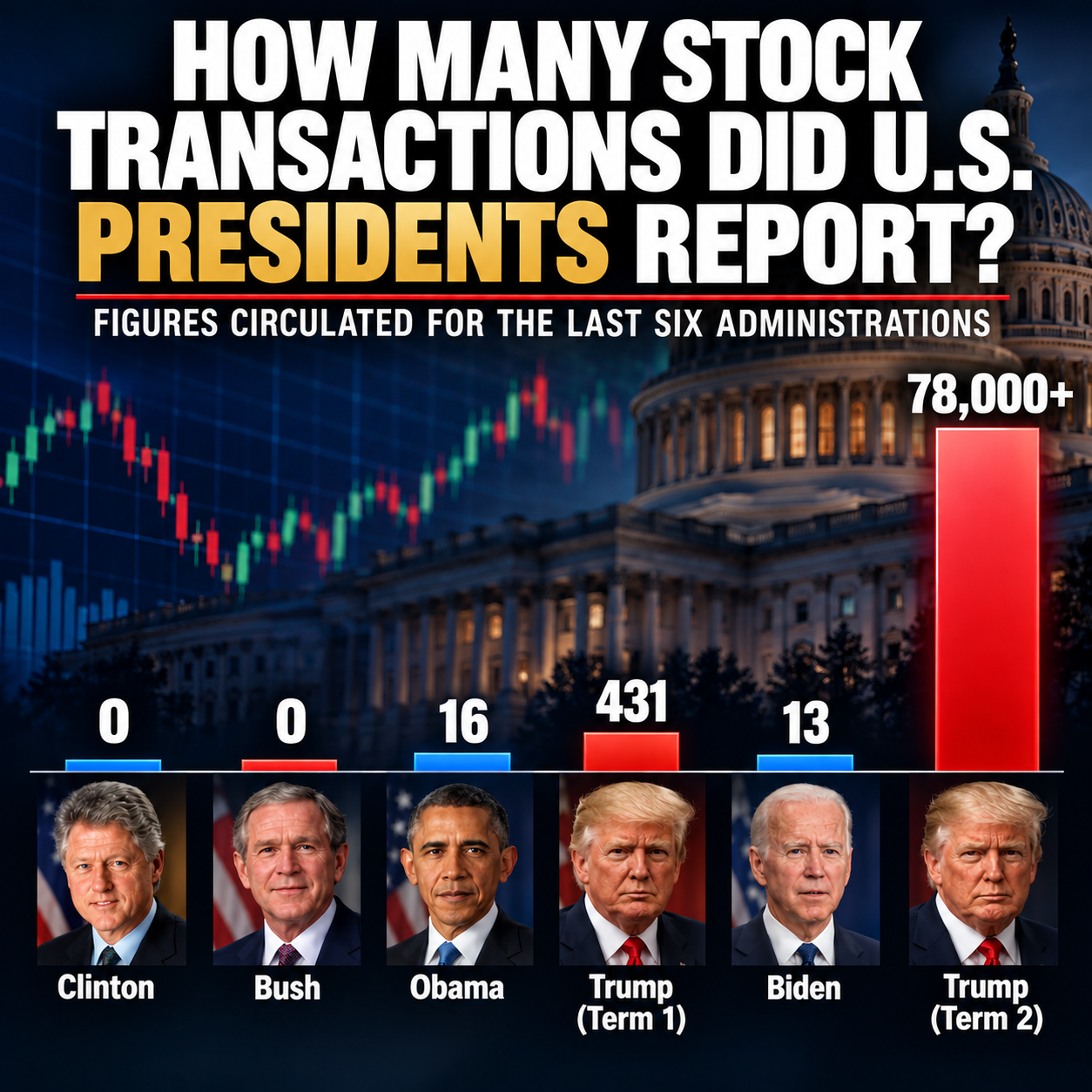
Required financial disclosures reveal that Trump continued buying and selling shares in major energy companies—such as ExxonMobil, Chevron, Valero Energy, and Marathon Petroleum—during the Iran war. He has often changed his messaging just prior to market openings in what analysts claim were attempts to calm markets only to cause spikes in oil prices days later in what investigators believe were attempts to drive-up oil prices. There is cursory evidence Trump’s oil stock portfolio purchased heavily after driving down oil prices with his calming rhetoric only to wildly profit days later after using belicose language to spike market prices. An examination of Trump’s portfolio and the investment of his family surrounding the Russian oil deal will undoubtedly be examined with a view toward prosecution.
This may also explain the importance of Trump attempting to gain a release of liabiity for himself and his family members from Internal Revenue investigations and liability “for life”. As reported by Politico, the 11th Circuit Court of Appeals concluded Trump’s lawsuit against the IRS was essentially manufactured by collusion to justify a deal that would extinguish all outstanding federal tax liability for Trump, many of his family members and his businesses.
Trump’s position has no doubt been emboldened by a compliant Republican party which has abdicated its Constitutional obligation of oversight while controlling the two houses of the US Congress. Both the House and Senate have not only failed to hold hearings on a gambit of issues that would normally raise oversight concerns but have remained silent while Trump has resorted to using Executive Orders to usurp Congressional powers provided for in the Constitution.
The destruction of the institutional pillars which once ensured the three co-equal branches of US government worked properly has been copperfastened by the US Supreme Court in Trump v. United States. On 1 July 2024, the Trump-packed Court ruled in a 6–3 decision that former presidents have broad criminal immunity for official actions taken while in office. With the presumption that Trump enjoys immunity for “official acts” he has been emboldened to press beyond the boundaries any US President has tested before.
Trump’s only restraint to his unbridled exercise of near dictatorial powers has been political considerations. However, having been convicted of 34 felony crimes, losing several civil lawsuits including sexual abuse the judge described as being tantamount to rape as well as being forbidden to operate a charity in New York for having misused charitable funds for personal gain and other matters too abundant to list, Trump has shown no willingness to recoil from public life for what would shame and embarrass other politicians into obscurity. Even President Richard Nixon famously resigned in disgrace over the Watergate scandal after the House of Representatives voted to impeach him and being informed by his own party leadership he didn’t have the votes to escape impeachment by the Senate. The House voted twice to impeach Trump in his first term of office.
Will the threat of an ICC indictment now cause Trump to be more constrained? Given the oil deal struck with Putin Friday it seems unlikely.
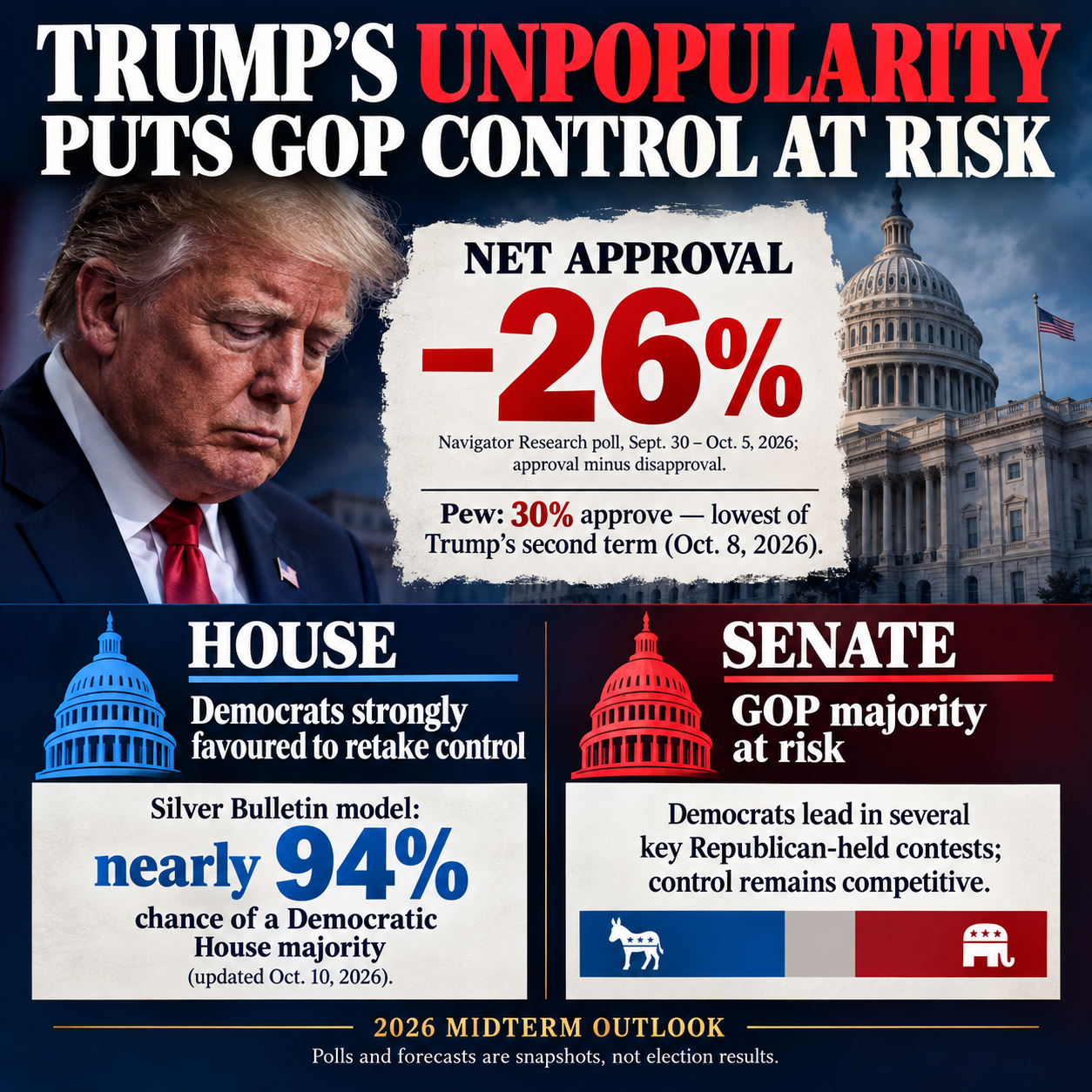 Trump’s legal and political future is highly reliant on the outcomes of the US mid-term elections in 3-weeks time. According to polling reported by The Economist, Trump now stands at an historic -26% net approval rating. He now ranks lower than his idealogical nemisis President Jimmy Carter―who had his own Iran woes―and only just above President Harry Truman who left office with a -22% net approval rating. Campaigning in the American heartland of Oklahoma on Tuesday, Trump told the audience, “Pretend I’m running, please. Just because I am on the ballot and if we don’t win, they’ll end up impeaching me”.
Trump’s fear he will be held accountable in the event of the likely victory of the Democrats in taking both the House and Senate in the November elections is palpable. He may feel that exercising his Executive Order powers to enrich himself and his family further with the Russian oil deal may be one of his last opportunities to secure his family’s fortune. Reporting by The Guardian described Trump’s conduct in office thusly in quoting government ethics lawyer Kathleen Clark, “This is the looting of America’: Trump and Co’s extraordinary conflicts of interest…”.
The final analysis cannot yet be written. No political or judicial crystal ball exists that allows us to peer into the future to see if Trump’s once compliant Republican party allies block his oil deal with Putin. Neither can we at present avail ourself of evidence Trump has engaged in personal profiteering from the wars in Iran and Ukraine as he has in almost every other aspect of public policy under his influence. Still, he cannot afford to continue being so cavalier. His much claimed “genius IQ” has not managed to help him hide voluminous amounts of evidence of his crimes as evidenced by documentary evidence and testimony used during trials leading to his 43 felony convictions and numerous findings of personal liability in countless civil lawsuits. If evidence exist he profited from the Russian oil deal Trump will face new legal problems. As it is no almost irrefutable from the public record he conspired to aid Russia in funding its war in Ukraine, knowing the Trump-Putin oil deal would inevitable fund the continued waging of Russia’s illegal war in Ukraine replete with war crimes, Trump may spend his retirement on a witness stand in the Hague instead of the golf links in Florida.