



by Miceál O’Hurley

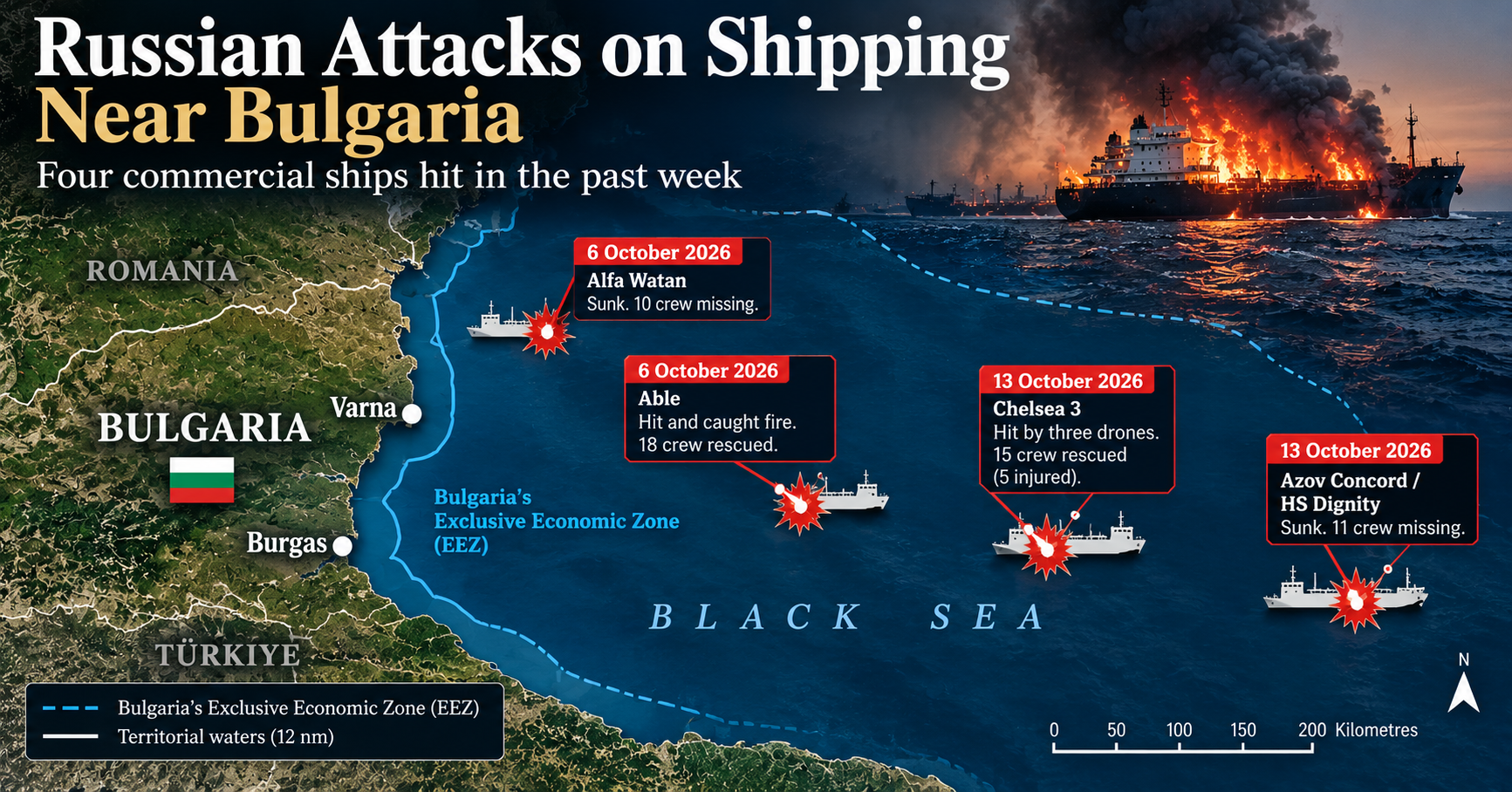
SOFIA ― Two more ships were struck today by drones and missiles off the Bulgarian coast bringing the total to four in the last week. Today’s attacks sunk one vessel and significantly damaged the other. According to Bulgarian Defence Minister Dimitar Stoyanov Six crew members on the Guinea-Bissau-flagged HS Dignity were rescued while ten others remain missing. After launching distress flares and signals, the HS Dignity sank in the pre-dawn darkness of following the attack that took place 17-nautical miles (31km) east of the village of Krapets near the Romanian border on the Black Sea.
The second vessel struck was the Ukrainian owned Chelsea-3. The ship was hit by drones 18-nautical miles from the town of Byala situated in the middle of Bulgaria’s Black Sea coast. The rescue of all 15-crew was reported.
The repetition of four attacks on shipping within Bulgaria’s Black Sea Exclusive Economic Zone (EEZ) in only a week represents an alarming escalation in attacks on freedom of navigation. Intelligence estimates have concluded the attacks have been carried out by Russia’s military. Moscow has long sought to assert control over the Black Sea following their illegal occupation of Crimea in 2014.
Russia’s escalation of attacks on freedom of navigation in Bulgaria may be designed to impede the right of Ukraine-friendly shipping while undermining NATO’s collective-defence commitment. Since taking power last year, the Government of Bulgarian Prime Minister Rumen Radev has tilted significantly towards Moscow raising concerns about Bulgaria’s commitment to NATO’s Article 5 collective-defence commitment. This tension arises at a time when US President Donald Trump has continued undermined confidence that the US will follow through on its own collective-defence commitments to NATO.
The attacks upon civilian shipping with Bulgaria’s EEZ on 6 and 13 October 2026, have brought the consequences of the Russia-Ukraine war uncomfortably close to NATO territory once again. Previous incursions of Romanian, Bulgarian and Polish air space by Russian missiles and drones failed to trigger any Article 5 response by NATO. Beyond exposing the vulnerability of commercial shipping in one of Europe’s most strategically important maritime corridors these attacks have once again served Russia’s goal of testing and undermining NATO’s willingness to defend Europe.
On 6 October, two merchant vessels, the Togo-flagged Alfa Watan and the Palau-flagged Able, were each struck by aerial and naval drones approximately 70-nautical miles off Bulgaria’s coast. The Alfa Watan sank, with its 10-crew members including 9-Syrians and 1-Egyptian, initially reported missing. The Able caught fire, although its 18-crew members were ultimately rescued. Ukrainian President Volodymyr Zelenskii blamed Russia for the attacks. Bulgarian Prime Minister Rumen Radev, however, condemned the attacks as a blatant violation of international and maritime law but did not initially affix blame to Moscow.
Despite no firm evidence having been confirmed at this time, Radev claimed the attack could have come, “[from] either side. The logic suggests that the outcome benefits the Russian Federation”.
Following that statement, Radev’s diplomatic response was to summon Russian Ambassador Eleonora Mitrofanova. Mitrofanova reportedly told Radev that violations of Bulgarian waters were “unacceptable”, but she had no information on the attacks from the Russian military. She is said to have then suggested the attacks could have come from ‘third-party provocation’”. Russia has repeatedly adopted a posture of deflecting from accusations of attacks and insinuating others are responsible despite evidence later emerging making Russian culpability inescapable.
The question inevitably arises: “How close did the Bulgarian attacks come to triggering an Article 5 response under the North Atlantic Treaty collective-defense obligation”?
The answer is that, despite the gravity of the incidents, Bulgaria seem demonstrably disinterested in asserting the four attacks approached the threshold of an Article 5 response. The distinction may lay in the attacks having occurred within Bulgaria’s EEZ, not its territorial sea. Bulgaria’s territorial claims into the Black Sea extend 12-nautical miles from its coastline. The latest attacks took place some 17-nautical miles from its shoreline. While the EEZ gives Bulgaria important sovereign rights and jurisdiction over resources and certain maritime activities, it is not normally considered to constitute sovereign territory in the same way as territorial waters. Moreover, Article 5 requires an armed attack against a NATO member. Bulgaria has decidedly determined these four attacks on commercial shipping do not automatically satisfy that threshold. None of the 4-ships that have been attacked in the last week are Bulgarian registered vessels.
Nevertheless, the escalation of attacks on Black Sea shipping and its regional impact remains considerable. Had the attacks struck Bulgarian naval vessels, military installations or personnel, or caused casualties attributable to a deliberate Russian operation against Bulgaria, the circumstances could have been substantially different. Resorting to Article 4 consultations, in lieu of triggering Article 5, became the operative mechanism for NATO coordination and consideration of the incidents.
The profound strategic and economic implications of these incidents should not be underestimated. Four ships struck, civilian sailors killed or missing, and a NATO member forced to seek urgent assistance in identifying the perpetrators represent a serious deterioration in Black Sea security. Impeding freedom of navigation continues to work to Russia’s benefit and the world’s detriment.
For Bulgaria, however, the economic impact of reduced shipping and transport could prove disastrous even if an Article 5 response was avoided. Bulgarian ports handle a combined shipping volume of some 30 million tonnes. The ports of Burgas and Varna serve as vital gateways for energy, grain, industrial commodities and container traffic.
Burgas alone handled approximately 19 million tonnes in 2024, more than half of it comprised of liquid bulk, including crude oil and petroleum products. Given US claims the Trump-Putin oil deal which relaxed sanctions and rewarded a cash-strapped Russia was necessitated by Ukraine’s pummelling of Russia refineries and port, Trump has made no comment about this latest threat to Bulgaria’s Black Sea oil transport.
Repeated attacks in Bulgaria’s EEZ create a real and measurable risk for increasing war-risk insurance premiums. The frequency of four attacks within the last will undoubtedly divert commercial traffic and undermining confidence in Black Sea freedom of navigation. The potential consequences are not confined to Bulgaria alone. Further Russian attacks on Black Sea shipping threaten the wider commercial corridor connecting European markets with the Caucasus, Türkiye and Central Asia.
For the much vulnerable Africa, however, reduced grain shipments could spill-over into spreading economic instability and hunger. Disruption to Black Sea grain shipping could have serious food-security consequences. The countries most vulnerable are those that depend heavily on imported wheat, have limited foreign-exchange reserves, experience political instability, or rely on subsidised bread as a staple food―generally all of the Middle East and Levant.
At present, the UN has listed Gaza/Palestine as well as Sudan as facing “catastrophic” food insecurity. Syria and Lebanon lag close being having been designated as suffering “critical” with Libya, Tunisia, Egypt, Morocco, Algeria and Jordan rated as facing “elevated” food insecurity. Russia’s attacks on Black Sea shipping threaten to tip the balance of food, political and economic stability for the entirety of the North African, Levant and Sub-Saharan African regions.
For now, the immediacy of NATO’s credibility has been catapulted into sharp focus. Ultimately, NATO’s deterrent effect has relied upon its perceived willingness to respond to an attack by invoking Article 5. The treaty-pact’s resolve to prevent the gradual normalisation of military aggression around its borders may rely on how it handles the continued deterioration of security norms presented by Russia’s attempts to create a Russkiy Mir.
The Black Sea is becoming a test of precisely that resolve. Bulgaria, arguably NATO’s most Moscow-friendly partners, may prove the deciding factor in NATO retaining its collective-defense credibility or being a vehicle by which Moscow continues to degrade an institution that stood at the heart of European peace and stability since being formed in 1949.