


by Miceál O’Hurley

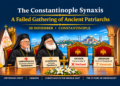
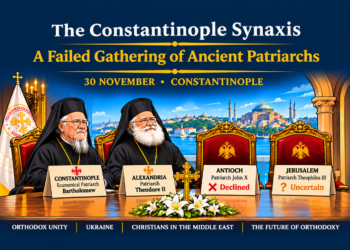
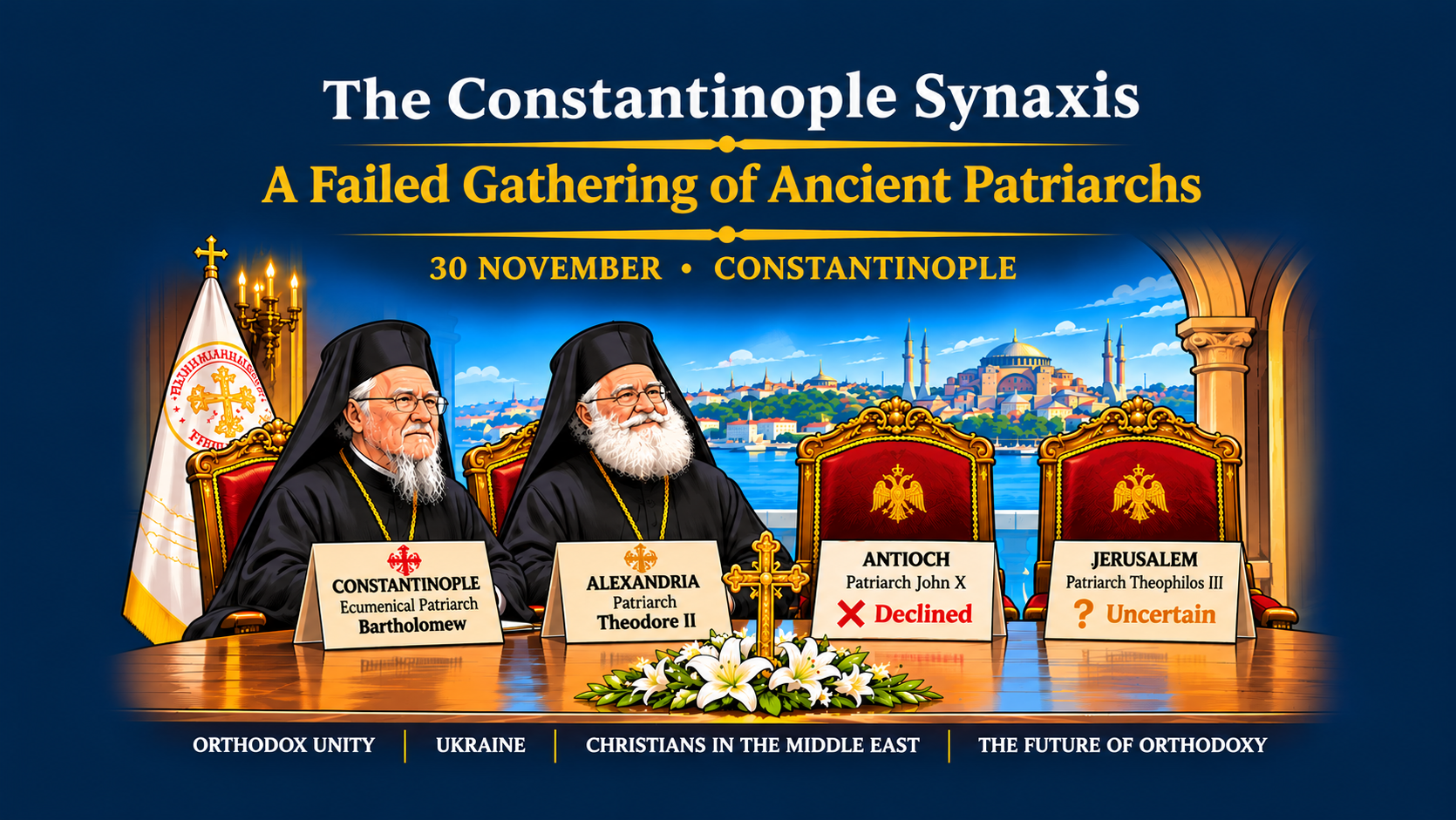
With Antioch rejecting Ecumenical Patriarch Bartholomew’s invitation to participate in a Synaxis, and Jerusalem’s attendance still uncertain just days before the gathering, the conspicuous presence of two ancient patriarchs in Moscow for Patriarch Kirill’s 80th birthday raises uncomfortable questions about the future or existence of Orthodox unity.
CONSTANTINOPLE — A carefully worded communiqué from Ecumenical Patriarch Bartholomew invited the four ancient Orthodox Patriarchates to attend a Synaxis in Constantinople upon the Feast of St. Andrew on 30 November. It was intended to be a profound demonstration of ecclesiastical solidarity in a deeply fragmented world. Instead, on the eve of the gathering, the rejection of the invitation by Antioch and with only two days left before the gathering, Jerusalem remaining aloof concerning attendance, the situation serves to underscore the very division the meeting was intended to overcome.
The Ecumenical Patriarch, who for almost 1,700 years has been called to be the steward of Orthodox Christian unity, is being accused by critics of exposing the divisions in Orthodoxy by inviting his fellow patriarchs to engage in Synaxis at a time of visible disunity. Learned students of Orthodoxy praise Ecumenical Patriarch Bartholomew for the courage to call his brothers and the faithful to unity even at a most difficult time.
The Ecumenical Patriarch’s invitations to Patriarchs Theodoros II of Alexandria, John X of Antioch and Theophilos III of Jerusalem presented a visible opportunity to restore cordial and fraternal relations between the ancient Apostolic Thrones at a time when a common response to the challenges confronting Orthodoxy and humanity abound. The initiative carried considerable symbolic importance and abundant practical opportunities to be relevant to the faithful and world beyond. The inability of four Patriarchs who mission and diakonia is to proclaim and practice unity to even sit at one table bodes ill for the relevance of Orthodoxy when the world cries out for help.
Relations between Constantinople, Antioch and Jerusalem have been visibly strained in recent years. Disagreements surrounding the Orthodox Church of Ukraine have been at the forefront of those tensions, but myriad other issues, some whose importance go far beyond jurisdictional disputes over a single local church, persist. Consequently, the question of Orthodox unity—and of the place of Constantinople within the Orthodox world—has occupied hierarchs, scholars, monastics, and the faithful extending well beyond the boundaries of the Church. These are not simply questions for the pan-Orthodox world―they are central to the human condition.
With only three days remaining, the anticipated Synaxis is already seriously compromised by the prospect of limited participation.
Patriarch Theodoros II of Alexandria is expected to attend. Patriarch John X of Antioch has declined the invitation. The remaining invitee, Patriarch Theophilos III of Jerusalem, has notoriously left his participation uncertain. That hesitation is particularly significant given the Jerusalem’s recent engagement with Moscow for the 80th birthday celebrations of Moscow Patriarchate Kirill. What is the world to think of prioritising a Moscow birthday celebration marked by overt Russian State messaging and symbolism over a consequential meeting in Constantinople about the future of the Church and humanity?
The timing could hardly be more awkward for Constantinople. The 20 November pilgrimage to Moscow by Patriarchs John X and Theophilos III to participate in Patriarch Kirill’s birthday festivities was cast by Moscow as a Russian State propaganda victory. Both concelebrated the Divine Liturgy at the Cathedral of Christ the Saviour alongside Kirill, Patriarch Porfirije of Serbia and Metropolitan Rastislav of the Czech Lands and Slovakia. The presence of the Antiochian and Jerusalem Patriarchs was especially notable given that both had received invitations to Constantinople only days earlier. Their attendance in Moscow was as foreseeably cast as an endorsement of the Russkiy Mir as the avoidance of the Constantinople Synaxis is being characterised as a rejection, if not condemnation of the Ecumenical Patriarchate.
The marked asymmetry between the demonstrative fraternity shown towards Moscow and the reticence displayed towards Constantinople raises an uncomfortable question being asked far beyond the confines of Orthodoxy: how could two patriarchs find common ground in Moscow to honour Patriarch Kirill given his ‘Holy War’ ideology antithetical to fundamental Christian precepts and yet remain reluctant to demonstrate the same willingness to gather with Ecumenical Patriarch Bartholomew at the Phanar to discuss the issues that confront Orthodoxy in modernity?
The issue is not whether Orthodox patriarchs should maintain relations with Moscow. Ecclesiastical dialogue should never be abandoned simply because disagreements exist. Rather, it is the apparent incongruity of engagement by Antioch and Jerusalem that risks amplifying Moscow’s use of schism to achieve Russia’s geopolitical aspirations at the expense of Constantinople and Christianity’s salvific goals indispensably rooted in unity. Both Antioch by its refusal to attend the Synaxis and Jerusalem by its ambivalence, knowingly diminish what remains of the already tenuous claims of Orthodox unity. When public expressions of fraternity are possible in Moscow, but an invitation from Constantinople encounters resistance, the credibility of appeals to unity inevitably suffers. The faithful, ecumenical partners and outside observers are left wondering whether a principled Orthodox ethos still provides common ground for engagement.
For Ecumenical Patriarch Bartholomew, Antioch’s rejection of the invitation and Jerusalem’s equivocal response represent a profound diplomatic and ecclesiastical setback. An initiative intended to reaffirm the historical responsibility of the ancient patriarchates to act together has instead been render an exercise is exposing a growing rift within Orthodoxy. The events of November have exposed the limits of the Ecumenical Patriarch’s ability to secure even their basic participation in dialogue and the attempt is being characterised as the rise of Moscow at the expense of Constantinople in a competition for influence.
The difficulty in attracting the other historic patriarchs to Constantinople echoes what was the long-awaited Council of Crete. Antioch’s absence at Kolymbari in 2016 cast a shadow over the proceedings. The refusal of Moscow and several other local Churches to attend deepened divisions and encouraged the emergence of competing centres of influence, with Moscow increasingly seeking to displace Constantinople as the principal reference point of the Orthodox world. The recent attendance of Antioch and Jerusalem at Patriarch Kirill’s birthday celebrations, while the Moscow Patriarchate, President Putin and Russian media proclaimed Moscow to be the ‘Third Rome’ contrasted with these patriarchs’ reluctance or failure to commit to the gathering in Constantinople, underscores how fractured Orthodox unity has become. Still, it may be too soon to declare that by their attendance in Moscow both Antioch and Jerusalem have staked their flag in what has become a bi-polar competition to determine who influences Orthodoxy most.
There is a wider institutional question, and it goes directly to the preservation of pan-Orthodox life. The inability of the principal patriarchates to gather—even for an occasion of profound historical significance, such as the 1,700th anniversary of the Council of Nicaea—bodes ill for the Church. Nationalism has long distorted Orthodox ecclesiology. Russia’s willingness to harness that nationalism to reorient Orthodoxy into competing spheres of influence is turning confraternity into confrontation. The question is stark: can Orthodoxy be preserved without meaningful unity, or is it destined to become a federation of local Churches competing for institutional relevance, geopolitical patronage, and regional dominance?
The Apostolic Fathers understood the Church as one visible and spiritual body, rooted in Christ, united by apostolic teaching, sacramental communion, and a shared ecclesial life. Unity was not an optional aspiration or a diplomatic convenience; it was integral to the Church’s identity. The failure of contemporary patriarchs to sustain reciprocity and cooperation reflects a diminished understanding of that inheritance—one in which unity risks becoming a slogan rather than a defining characteristic of the Church.
The Moscow celebrations demonstrated that alternative centres of Orthodox influence can attract senior hierarchs, even when the result is to deepen divisions elsewhere. Constantinople must therefore confront a reality in which the historical primacy entrusted to it by councils, tradition and history does not automatically translate into universal ecclesiastical cooperation. More profoundly, Moscow’s increasingly assertive presentation of itself as a ‘Third Rome’ challenges the historic order of Orthodox communion. The attendance of Jerusalem and Antioch at Kirill’s celebrations, set against the uncertainty surrounding Constantinople’s Synaxis, inevitably strengthens that perception.
Yet it would be a profound mistake to regard the Ecumenical Patriarchate as merely one more institution competing for influence. Preserving the Ecumenical Patriarchate and the prerogatives invested in it by successive Councils through the centuries is critical to the future of Orthodoxy. Constantinople is relevant, and will remain so, precisely because its historic vocation has been to serve the unity of the Churches rather than the ambitions of a single nation or state. From the imperial splendour of Byzantium through the Ottoman conquest and centuries of political subordination, demographic decline and immense adversity, the See of Constantinople has endured. Its significance cannot be measured by territory, political power, or material resources. It rests upon its place in the canonical and conciliar order of the Church and upon a continuing responsibility to convene, mediate, articulate and defend the Orthodox understanding of ecclesial communion.
Ecumenical Patriarchate Bartholomew reminds the Orthodox world that the Church is neither a collection of national religious institutions nor an instrument of state policy, but the One Body of Christ, bound together by a common faith, sacramental life, and apostolic tradition. Its voice has helped preserve the distinction between the legitimate diversity of local Churches and the fragmentation of the Church itself. To weaken or marginalise Constantinople is therefore not simply to diminish one patriarchate; it risks removing an indispensable point of reference for pan-Orthodox dialogue and for an ecclesiology that places communion above nationalism and Christian theology above geopolitics. The Ecumenical Patriarchate is not beyond criticism, and its leadership must continue to exercise its responsibilities with wisdom and restraint that have sometimes been found wanting. Still, its preservation is a concern for the whole Orthodox Church.
Whether Patriarch Theophilos travels to Constantinople on 30 November for the Synaxis is no longer an imperative. The deeper issue is whether the Orthodox Churches retain the collective will to overcome their divisions and preserve communion, or whether the Church is witnessing a symbolic tearing of the temple veil. Orthodoxy may continue to be invoked as the name of a Christian tradition, but without visible communion it reduces itself by self-inflicted wounds to be a mere loose association of local Churches, each claiming to preserve the true faith while neglecting the very unity that gives that claim ecclesial meaning.
If relations between the four ancient Patriarchates have become so inimical that they can no longer find the means to convene around the same table, the prospect of Orthodox unity risks being reduced to little more than a lament. Without a renewed and sincere commitment to genuine pan-Orthodox dialogue, the autocephalous Churches will increasingly find themselves drawn into rival blocs, beholden to political centres whose interests are not necessarily those of the Gospel. The danger is not legitimate local autonomy; it is the subordination of ecclesiastical life to the logic of power and politics.
For Orthodox Christians in Gaza, these are not abstract questions of jurisdiction or primacy. They are living through the destruction and damage of places of worship, the deaths and displacement of neighbours, and the steady disappearance of the communities with whom they have shared their lives. In Damascus, the faithful have experienced the horror of a terrorist attack on their church, while a Christian archbishop has been physically assaulted. Across Africa, Orthodox communities often struggle with profound shortages of clergy, funding, and basic resources, leaving vulnerable faithful exposed to economic pressures and inducements to exchange one Orthodox jurisdiction for another. And throughout the global diaspora, Orthodox Christians can find themselves without a priest, a confessor, access to the sacraments or the sustaining presence of a worshipping community. These are not peripheral concerns but matters touching the most basic conditions of Christian life: safety, pastoral care, worship, belonging and the continuity of the Church in the places where people actually live.
Against this human reality, the inability or unwillingness of patriarchs to gather and discuss the circumstances confronting their faithful is profoundly troubling. When patriarchs cannot overcome their differences to address the fundamental suffering of their own faithful in the world the Church risks appearing if not actually being indifferent to the human realities and pastoral needs that should lie at the very heart of its mission.
Orthodoxy faces enormous challenges: conflict in the Middle East, the persecution and displacement of historic Christian communities, war, secularisation and an increasingly complicated relationship between Church and State. These challenges demand cooperation, not competing ecclesiastical loyalties. The faithful require their patriarchs to speak and act together—not merely when it is convenient―but especially when unity is difficult.
On 30 November, Bartholomew may still receive a delegation and celebrate the Feast of St Andrew. Even if Jerusalem attends at the last moment, or if Antioch sends a delegation in the absence of its Patriarch, the larger objective of bringing the ancient patriarchates together to address the spiritual and human needs of the people of God has already suffered a serious setback. At the heart of these discussion lies a confrontation of the future of Orthodoxy and its very existence. Jurisdictional pluralism has always been part of Orthodoxy but unity has been essential to its purpose. If the ancient Patriarchates cannot even find common ground to convene and address matters of fundamental importance, owing to the very absence of unity that is essential to the identity and integrity of Orthodoxy, then the prospect of the Orthodox tradition fragmenting into an increasingly multitudinous, diverse and divergent landscape—resembling the divisions that have come to characterise Protestantism—must be regarded as a very real albeit regretable possibility.
The question confronting Orthodoxy is no longer whether unity is desirable. It is whether its leaders still believe it is possible—and whether they are prepared to defend the institutions and ecclesiology that make it possible so that Orthodoxy survives.
___________________________________
A version of this article appeared on 27 November 2026 in Greek on the Omologia.gr website