



by Miceál O’Hurley

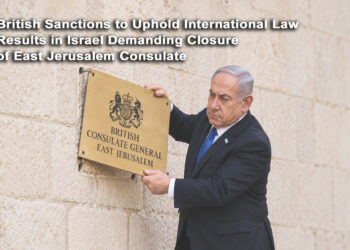
LONDON ― Bilateral relations between the UK and Israel have devolved into tit-for-tat retaliatory actions arising from the United Kingdom sanctioning Israel for its role in allowing, if not promoting, illegal settlements in the West Bank. What began as diplomatic tension has escalated to economic sanctions, restrictions on diplomatic engagement and Israel ordering the closure of the British consulate in East Jerusalem. According to the National Library of Israel, the British have maintained the Consulate in East Jerusalem since 1839.
The dispute poses and increasingly asked question: “Is it possible for governments use sanctions to uphold international law without exposing their diplomatic institutions to retaliatory coercion”?
Britain’s increasingly critical position towards Israeli settlement policy reflects growing frustration among Western governments over the expansion of settlements. While Israeli Prime Minister Benjamin Netanyahu has often condemned Jewish settlers who attacked two Palestinian villages in the occupied West Bank. He has claimed settler rioters as violations of law that Israel’s international standing. However, Netanyahu has failed to sanction his coalition partner and Israel’s Minister for National Security Itamar Ben-Gvir who is regularly seen taunting Palestinians and whose policies ensure settlers engaged in violence or occupation of Palestinian’s homes go largely unpunished.
Within the past 24-hours, Netanyahu announced his Government would defy an order of Israel’s Supreme Court to establish a firm timetable for Palestinians to return to their homes and land in the West Bank. Despite the ruling Israel’s highest Court, Netanyahu claims the Palestinians have no rights he is bound to respect or uphold, saying, “These are not residents, these are terrorists”.
On September 29, 2025 US President Trump announced he and his “Board of Peace” had reached a reconstruction agreement, officially known as the Comprehensive Plan to End the Gaza Conflict, that would allow for an immediate ceasefire, the return of all hostages, prisoner exchanges, the demilitarization of the Gaza Strip, the deployment of the International Stabilization Force, transitional governance by Palestinian technocrats under international supervision, large-scale reconstruction, and a conditional pathway toward acceptance of Palestinian self-determination and recognition of Palestinian statehood. It was signed on October 9, coming into effect the following day, and was endorsed by the United Nations Security Council on November 17.
The so-called ceasefire has not resulted in a cessation of military strikes by Israel despite reflecting a reduction in the conflict. Palestinians complain reconstruction has not commenced, despite the passage of over 1-year since the agreement was ratified, leaving them either displaced throughout the Middle East or the remnants of the Palestinian population of Gaza, predominantly living in makeshift tents for shelter. Access to clean water, medical care and basic services remains limited. Food scarcity continues to be classified at catastrophic levels. The lack of recovery has resulted in thousands of bodies remaining buried by rubble and concerns over disease remains elevated.
While Gaza remains in a desperate situation, life for Palestinians in the West Bank continues to be difficult. Increasing numbers of illegal settlers expand Israeli settlements in violation of numerous UN resolutions and prevailing international opinion hold that Israeli settlements are a violation of international law. UN Security Council resolutions 446 in 1979, 478 in 1980, and 2334 in 2016 have classified Israeli settlements in occupied Palestinian territory as illegal. A reconvened Conference of the High Contracting Parties to the Geneva Conventions declared the settlements illegal in 2014 with the concurrence of the International Committee of the Red Cross.
Videos of armed Israeli settlers expressing Zionist ideology, many from the United States whose living is subsidised by financial benefits, tax breaks and direct government subsidies paid to them by the State of Israel, appear daily depicting attacks on Palestinians that drive them from their homes. This conduct is often carried out in the present of Israel Defense Force personnel who have at times been depicted assisting settlers in the violent attacks. Palestinian activists complain the annual US military subsidy of $3.8bn represents direct relief to the State of Israel which results in Israel providing indirect financial support to settlers despite their presence, occupation and violent activities being contrary to international law.
In the context of continuing escalation of illegal settlement in the West Bank marked by increasing violence, London’s sanctions were introduced to enhance its longstanding refusal to recognise Israeli sovereignty over Palestinian territories occupied since 1967. The sanctions are narrowly defined targeting individuals associated with settlement expansion and restrictions on commercial activities connected with occupied territories. London hoped the use of sanctions would be seen as an attempt to move beyond diplomatic condemnation and orient action towards practical consequences. Israel’s reaction not only rejects this approach but further escalates the faltering bilateral relations.
Britain’s sanctions come at a time of wider international legal concerns about Israeli activities in Gaza and the West Bank. Following, the International Court of Justice’s July 2024 advisory opinion concerning the legal consequences of Israel’s policies and practices in the occupied Palestinian territory a growing consensus that Israel no longer feels bound by international law has emerged. For Israel, however, these measures represent an increasingly hostile European and international political environment.
The Israeli Government has rejected Britain’s approach. In retaliation, it has responded with measures affecting bilateral diplomatic cooperation, including ordering the closure of the British Consulate General in East Jerusalem. Established in 1839, the diplomatic mission has historically represented British interests concerning the Palestinians and maintained an important presence in East Jerusalem under the belief that Jerusalem should be a shared city separate from Britain’s embassy in Tel Aviv.
Its status reflects the international community’s refusal to recognise Israel’s annexation of East Jerusalem or its sole claim as a national capital. Both Israelis and Palestinians claim Jerusalem as their capital. East Jerusalem was captured by Israel in 1967 and later annexed in a move that the international community views as an occupation or does not legally recognise. UN Resolution 478 called upon member States to withdraw embassies from Jerusalem in an attempt to preserve peace and assert a neutral posture.
Consequently, the dispute extends beyond the administrative future of a diplomatic building. At the heart of Israel’s decision to order the closure of the British Consulate in East Jerusalem is whether a State can effectively restrict another state’s diplomatic representation because it objects to that state’s foreign policy. The Vienna Convention on Consular Relations requires both States to mutually consent to the presence of a diplomatic mission. Israel’s unilateral step in ordering the closure of Britain’s Consulate in East Jerusalem begs the question, “Is Israel’s position tantamount to severing diplomatic ties with the United Kingdom”?
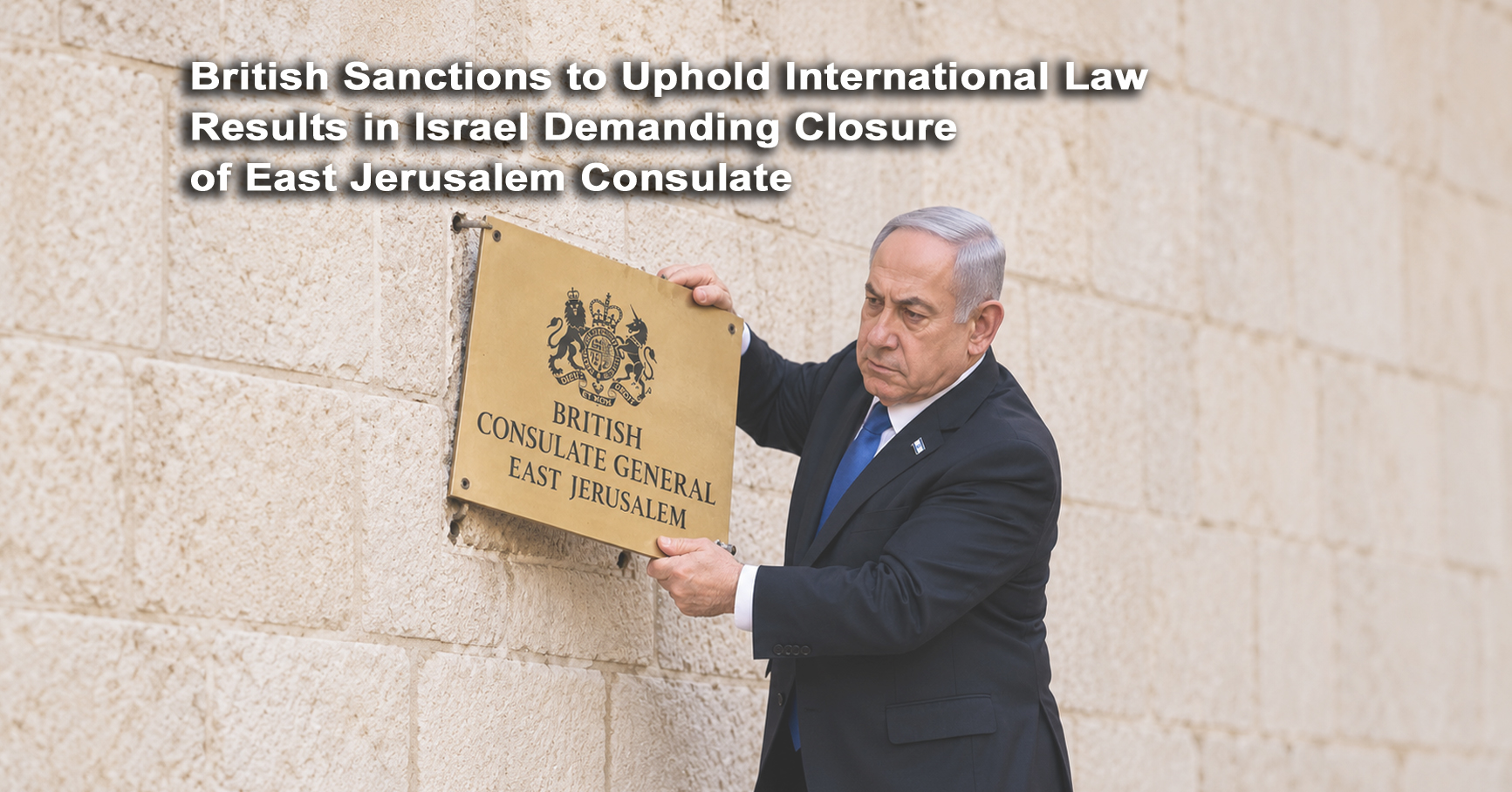
Reports of possible British retaliation, including the expulsion of Israeli diplomats, raised the prospect of a more serious diplomatic rupture. Israel forcibly removed the British Consulate’s signage from the building then announced that 20-British diplomats, including the consul general, are required to leave the country immediately. Although governments possess considerable discretion under Article 9 of the Vienna Convention on Diplomatic Relations to declare diplomats persona non grata, reciprocal expulsions can rapidly undermine the communication channels essential to managing international disagreements.
Britain’s Foreign Secretary, Ed Miliband, indicated last week his Government had decided the consulate building would remain but would be downgraded to the “UK Mission, Jerusalem”. Diplomatic missions are not simply administrative outposts―they are essential instruments of communication, negotiation, intelligence liaison, and crisis management. Israel wishes to degrade British influence in the State and Occupied Territories by forcing the closure of the British Consulate. Israel has also Removal of British representatives from the International Assistance Centre for Gaza; demanded an end to British assistance and training of Palestinian Authority forces in the occupied West Bank; and, announced the denial of entry of 12-elected officials and other British citizens involved in “anti-Semitic and anti-Israeli activity”.
Israel’s decision to limit or cease diplomatic representation as a tool to gain leverage in unrelated political disputes is risky. If States were to use this tactic as a precedent whereby governments threaten foreign missions whenever confronted with unwelcome criticism or sanctions the ability of States to speak frankly to one another would quickly dissipate. Further developments along this line by Israel or other States would undermine the foundations of accepted international diplomatic framework, particularly for smaller states whose influence depends heavily upon established international protections.
Britain’s confrontation with Israel reflects is not merely parochial. A broader European reassessment of how to respond to increasing settlement expansion and the erosion of Palestinian territorial prospects has become pressing because of the scale of the current crisis. For years, European governments have relied principally upon diplomatic engagement, development assistance, and support for a negotiated settlement. Increasingly, however, there is recognition that dialogue without meaningful consequences may have limited influence over the hardline Netanyahu coalition government.
In practical terms, while sanctions have always been a regrettable but acceptable too to abate military action, sanctions are no substitute for diplomacy. Sanction regimes depend upon clearly defined objectives, proportionality, international coordination and a credible, incentivised pathway towards underlying conflict conditions and eventual termination. Absent these safeguards, sanctions risk becoming instruments of political confrontation rather than mechanisms for achieving policy change.
The question for both parties remains. For Britain, “Will sanctions produce a desirable change in Israeli settlement policy”? And, for Israel, “Does the State of Israel run the risk of itself becoming isolated by States who might order the closure of Israeli missions over internal Government policy”?
The British Israeli dispute illustrates the vulnerability of traditional alliances when fundamental disagreements emerge take on an intransigent nature over international law and national policy differences. Neither country benefits from a sustained deterioration in relations. Intelligence cooperation, counterterrorism, technological development, and regional security remain important, shared interests.
The strength of diplomacy is never measured by the absence of disagreement but by the ability of States to manage differences without destroying the very institutions through which peaceful relations are maintained and where security and prosperity are most likely to flourish.
Britain’s determination to preserve its diplomatic presence in East Jerusalem, while avoiding an immediate cycle of reciprocal expulsions, demonstrates the importance of restraint. Israel’s escalation of diplomatic tensions may only serve to further isolate it at a time of increasing regional tension.
The wider diplomatic and political lessons are unequivocally important―sanctions may be legitimate instruments of foreign policy, but normalising retaliatory threats against diplomatic missions is unacceptable. Effective international relations require consistency. Diplomatic polity requires access. International stability requires both.
The preservation of diplomacy is not a concession to political opponents. It is itself a strategic interest by which both sides to this dispute benefit and should therefore preserve.