



by Miceál O’Hurley

TEHRAN — With little hope for any outcome but an agreement to continue dialogue without the use of military force, last Friday’s indirect dialogue in Muscat failed to produce a discernable outcome. There was no indication of any deal having been reached. US negotiators, Trump insiders and billionaire real estate moguls Steve Witkoff and Jared Kushner gave no positive indications following the meetings. The duo, a long-time Trump friend and the son-in-law of President Trump, did visit the armada’s aircraft carrier the USS Abraham Lincoln following the meeting hinting it might prove a memorable photo opportunity for any possible attack on Iran that may soon follow. Ostensibly, their visit to the aircraft carrier leading a strike force in the region was meant to highlight the buildup of offensive military capabilities of the US now threatening Iran. Last week, Trump warned Iran’s Supreme Leader, Ayatollah Ali Khamenei, that he should be “very afraid” signaling a possible use of force by the US being imminent.
Diplomats on both sides, regional partners as well as observers worry the indirect communication format continues to work against the parties reaching any durable accord. Moreover, the Trump Administration’s selection of generalist envoys Witkoff and Kushner stand in opposition to Iranian Foreign Minister Abbas Araghchi. Araghchi honed his skills as a negotiator and subject matter expert during the JCPOA negotiations where he was Iran’s lead negotiator. Sending subject matter novices to negotiate with Araghchi undermines any belief a US commitment to a negotiated settlement is either desired or likely.
Trump’s decision to send un-skilled envoys without subject matter experts to deal with this crisis represents a structural and operational obstacle to progress. Witkoff and Kushner are already overwhelmed with their tasks as negotiating leads in the still indeterminate Palestine-Israel peace process where Palestinians still suffer death by malnutrition and violence months after Trump hailed his peace deal. In Ukraine, where Witkoff and Kushner have led negotiation with Russia and Ukraine based upon Trump’s 20-Point Peace Plan the peace Trump promised would be “Easy. I will solve it within 24-hours” continues to costs thousands of lives each month and the untold suffering of Ukrainian civilians enduring Russia’s attacks on civilian housing and critical infrastructure which can be defined as war crimes in international law.
Any real prospect for advancing negotiations would foreseeably require the involvement of subject matter experts and experienced career diplomats to deal with the highly technical issues of nuclear energy and enrichment, theatre ballistic missiles, human rights violations and sanctions relief. Beyond Witkoff and Kushner having scant time and resources to devote to complex, high level conflict negotiations at one time bodes ill for any real progress being made and undermines realistic expectations for any substantive progress.
As for human rights issues in Iran, critics point out Trump’s own use of heavy-handed tactics and killing of civilians related to Americans protesting his policy of aggressive removal of what he deems “illegal migrants”. While Trump’s Department of Homeland Security (DHS) ICE agents are forbidden from conducting operations against American citizens an increasing number of Americans are arrested without warrants, injured (some severely) or killed by ICE and Border Patrol agents seeking to meet arrest and removal quotas propelled by cash bonuses. While in no way on the scale of deaths or arrests that occurred following the January protests and crackdown in Iran, critics cite Trump’s own disinterest in human rights in claiming his policies and personal decisions as President show contempt for human rights, the Constitution and the law.
During my latest appearance on Al Qahera News last Friday I expressed my concern that Trump pre-positioning a naval strike force in the region combined with his tendency to divert attention from his domestic woes by using military force points towards an American predisposition to attack Iran. Trump’s latest approval ratings are deeply in negative territory even on issues on which he once, and quite recently, commanded significant support. Trump’s overall approval rating in the latest Marist/PBS February poll show increasing dissatisfaction with his performance after 1-year into his second, non-consecutive term in office. The drop is support appears even amongst his most stalwart supporters.
The latest Quinnipiac University survey, compared to its poll last month, Trump’s approval rating declined a full 3-points, falling to only 37%, with the same survey showing 56% of Americans disapprove of his job performance. Trump’s inability to meet his pledged improvement in reducing inflation, creating jobs, lowering food prices, cutting energy costs and implementing his border security-immigration programme without significant domestic political dissatisfaction lies at the core of his domestic agenda woes. His Make American Great Again (MAGA) base of voters is also showing signs of discomfort with Trump’s pledge to extricate America for foreign entanglements – a key plank in his electoral manifesto.
Trump’s remarkably low approval ratings and the growing dissatisfaction amongst voters, as reflected by the most recent polling numbers sustaining that trend, have caused discomfort in the White House and in Trump’s Republican Party. Signs of increasing concern are evidenced by what were his most compliant House and Senate party members now openly challenging Trump on any number of issues. As the Congress and Senate face re-election campaigns in 2026 their willingness to stand in opposition to Trump arises by their more parochial reelection concerns.
Wednesday, 6-Republicans crossed the aisle and voted with the Democrats, giving them the majority to vote down Trump’s tariffs – a cornerstone of his Unilateral Executive Power theory placed into practice by continually usurping traditional and Constitutional Congressional powers solely to himself. Last night, über-loyalist Speaker of the House of Representatives Mike Johnson condemned Trump’s Attorney General for spying on Members of Congress. Commanded by Congress to publish the Epstein Files, the Attorney General’s Department of Justice released redacted records, frequently obscuring the names of pedophiles and high-powered individuals while exposing the names of victims. Republicans and Democrats alike have accused Bondi of doing Trump’s bidding by protecting abusers while sending a chilling message to the more than 1,000 victims of pedophilia, child trafficking, procurement of women and children for prostitution and other crimes. While testifying before Congress, Bondi continued to refer to a binder that contained pictures of Congressmen and Congresswomen while they exercised their oversight duties by viewing unredacted copies of the notorious Epstein files. By photographing their individual actions and logging their search terms, Bondi’s Department of Justice seemed to be intently interested in determining where they had weaknesses in protecting wealthy and influential individuals.
By contrast, more than a dozen victims and family members of Epstein’s abuse were introduced at the hearing. Bondi refused to look at them or acknowledge them as they held up their hands in response to a questions as to how many continue to go without being interviewed. In what can only be described as a combative hearing, Bondi denied there was any proof Trump was engaged in any abuse of minors or had knowledge of Epstein’s criminality. When confronted with evidence that went un-investigated, citing a report her Department released as part of the Epstein files indicating a limo driver overheard Trump and Epstein discussing crimes and sexual abuse that made the driver want to “attack” Trump, Bondi refused to acknowledge the report or explain why it went un-investigated.
The balance of political power in the House and Senate generally shifts in favour of the President’s opposition in mid-term elections. Trump’s accelerating unpopularity shows every indication it will drag down Republicans’ chances of restraining the anticipated Democratic Party victory wave most pundits and polls predict. Trump’s concerns are not party political or policy oriented — they are pointedly personal. On 6 January, Trump told assembled Republican Party leaders, “You got to win the midterms, because if we don’t win the midterms, it’s just going to be — I mean, they’ll find a reason to impeach me,” Trump said in a speech at a House Republican policy retreat. “I’ll get impeached“. Increasingly, Trump conflates his personal protection with the security of the United States.
As with Trump’s demand for Greenland, linking it to having been refused the Nobel Peace Prize and launching attacks on Venezuela on 3 January, both coincided with the release of the explosive Epstein Files in what opponents claim is a Trump attempt to divert attention from himself and project strength to shore-up support from his base. Trump continues to maintain his denials he appeared in the Epstein files despite all evidence to the contrary. The now released files, with 3-million more documents yet to be released, represent a staggering blow to Trump’s denials and many of his associates. With Congress gaining access to the heavily redacted copies already posted publicly, online, and demanding that the continued redaction of documents to which they have access violates the law and prohibits their Constitutional oversight capability, Trump’s credibility has evaporated over what are not clearly his untruthful denials.
The New York Times reports Trump appears no less than 5,300 times in the un-redacted portions of the already heavily censored documents the US House of Representatives and US Senate compelled the Department of Justice to release. Following the Congressional testimony on oath by Trump’s Attorney General, Pam Bondi this week, growing public opinion now points to widespread belief she has breached her duty as Attorney General to represent the American people and the Constitution and is instead acting as a personal attorney to Trump. This is outside of her remit as Attorney General and breaches the traditional long-arm relationship between an Attorney General and the President that appoints them. Revelations that Bondi ordered the Department of Justice to spy on Members of Congress while accessing the supposedly unredacted copies of the Epstein Files and record their search history of the documents represents an unprecedented offense against the Separations of Powers between the Executive and Legislative Branches.
Scrutiny of Trump’s past behaviour inescapably militates towards him unilaterally exercising decisive and disruptive power on the international scene to distract from his ever widening and deepening domestic problems. Trump’s erratic, transactional exercise of power in foreign affairs is often counter intuitive and restricts America’s ability to act globally. This has been true of his use of tariffs even against America’s largest and long-standing trading partners and allies as well as his use of military force. The consequences have been devastating. The effects will be of long duration. After encouraging Venezuelan opposition actors, including Nobel Peace Prize winning María Corina Machado, Trump pivoted after seizing President Nicolás Maduro in a pre-dawn military operation and has taken no steps to restore democracy or displace the ruling regime. The Trump administration has done little to restrain the continued persecution of civil society actors, journalists and regime critics in Venezuela instead focusing on maximising profits from its natural resources and restricting the flow of oil to Trump’s international, ideological enemies.
The abandonment of democracy and protestors in Venezuela has had a chilling effect on protestors in Iran. Following Trump vocally encouraging economic protesters to transform their demonstration to regime change activities last month, coinciding with violence attending what had been until then relatively peaceful protests, Trump pledged to the protestors he encouraged, “help is on the way”. It never came. Like the Venezuelan opposition, they continue to pay a high-price for their activities.
My conversations with several Iranians in Tehran, Masshad and Ahvaz that supported or participated in the 2 week-long economic protests fear Trump’s renewed focus on the Iranian nuclear programme is merely an excuse for the US to use military force to topple the Islamic Republic of Iran. All opined that without any national consensus as to who should take power should such an eventuality be realised, they would be rendered, as one Iranian said, “pawns not people – like the Venezuelans”. None of the Iranians to whom I have interviewed believe there is any consensus around any opposition figure capable of garnering national support if Trump manages to bring down the Islamic Republic of Iran. All expressed concern that external pressure on Iran is welcome but destabilisation by force is likely to create the kind of chaos Iraq endured following the fall of the Bathists.
It is not surprising Trump failed to deliver his promised aid to Iranian protestors. He should have known this when he pledged American support. Trump’s foreign policy adenturism has rendered America diplomatically impaired and militarily impotent to then act in Iran. The necessary military resources required to for Trump effectively fulfil his promised mission to help Iranian protesters were on-station off the coast of Venezuela.
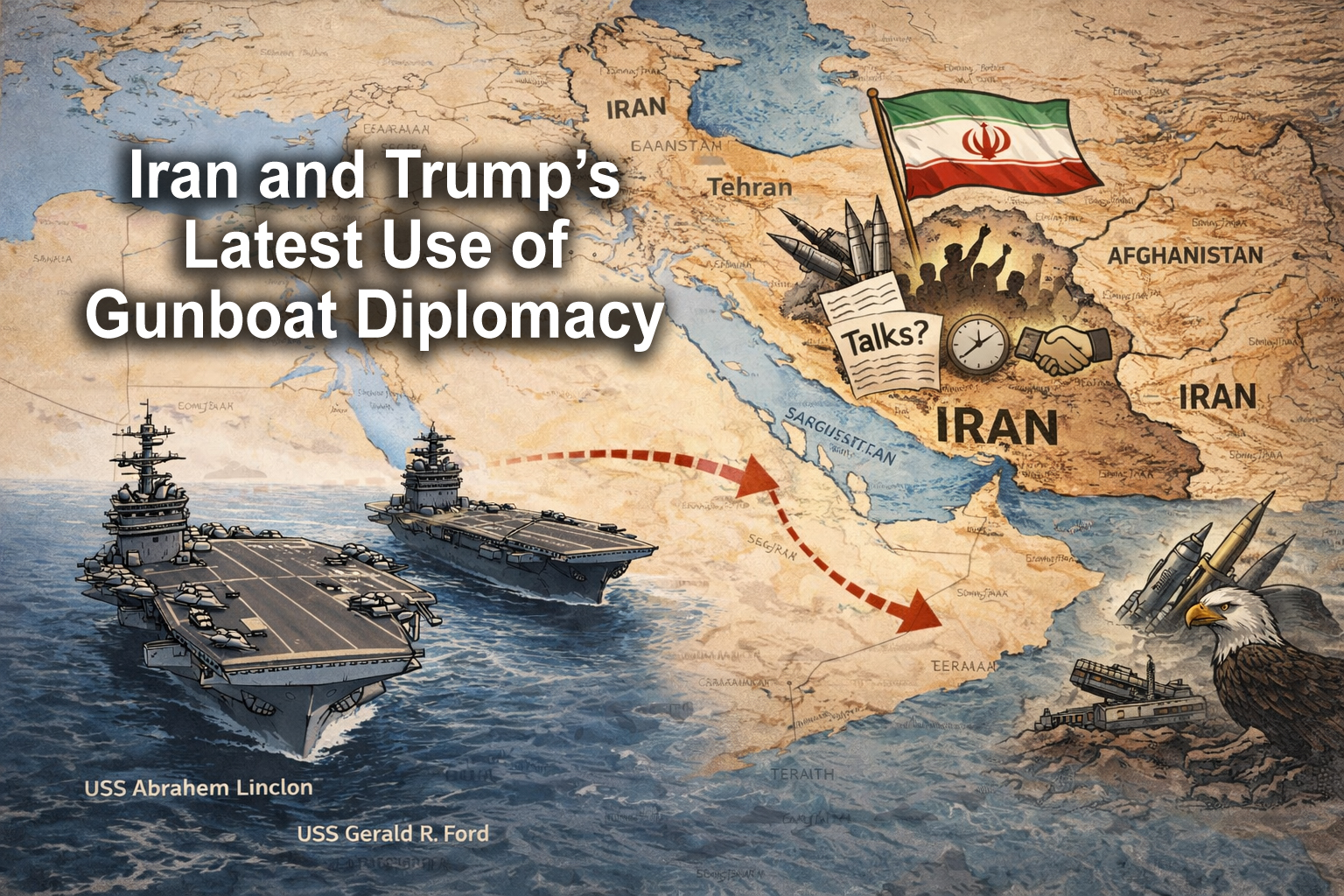
The situation has now markedly changed. Trump has secured his position in the seizure and sales of Venezuela’s oil and gas resources. He has deprived his arch-enemy Cuba of the cheap oil that only last month propped up that government. Trump has not bothered himself to promote democracy, justice or reform in-country, leaving Maduro’s hand-picked associates to continue to administer the country which does not place significant demands on his resources or agenda. All this left trump free to reposition a US armada, including the aircraft carrier and naval strike force with the USS Abraham Lincoln at its helm, to the region. He has since escalated his military resources for use against Iran. In the last 24-hours, Trump announced he is doubling the size of US military assets positioned to threaten Iran by adding a second carrier strike force including the aircraft carrier Gerald R. Ford.
Trump’s bellicose rhetoric is now finally aligned with the resources needed to make good on his threats. When asked about attacking Iran last week Trump replied to pool reporters, “the Ayatollah should be very afraid“. Trump’s rationale for striking Iran now has morphed from being one of supporting anti-regime protestors to claiming Iran has renewed its pursuit of achieving nuclear weapons capability.
Such claims are at odds with his previous assertions his attacks on Iran’s nuclear weapons programme last summer destroying their ability to enrich uranium to the levels needed for weaponisation. Trump has also claimed Iran needs to dismantle is ballistic weapons programme.
Israeli Prime Minister Benjamin Netanyahu paid a visit to the White House to encourage Trump to bolster Israel’s security. Netanyahu continues to be a proponent of attacking Iran to destroy its capability for launching ballistic missiles at Israel. Iran is estimated to maintain a diverse arsenal of ballistic missile systems including the short-range Shahab-1and Shahab-2 liquid liquid-fueled missiles. It’s array of ballistic missiles also includes the improved-range and accuracy Shahab-3 missiles as well as the hypersonic Fattah-1. Iran’s ability to effectively deploy their ballistic missiles is severely impeded, however, by last year’s near destruction of its anti-aircraft system.
Following last week’s indecisive talks between the US and Iran in Muscat, the likelihood of diplomacy averting further US military strikes on Iran appears unlikely. No new rounds of talks have been announced by Washington or Tehran.
Following his meeting with Netanyahu this week at the White House, Trump posted on his Truth Social media account, “There was nothing definitive reached other than I insisted that negotiations with Iran continue to see whether or not a deal can be consummated“. He claimed to desire a “deal” to avoid further conflict but ominously wrote, “we will just have to see what the outcome will be“. Trump seems intent on leaving open the possibility of a kinetic strike by the US. while failing to aggressively pursue diplomatic resolution.
Iran has offered concessions, including some limits to its nuclear programme, in exchange for sanctions relief. To date, the US has rejected any such offers and continues to demand Iran’s unconditional cessation of its offensive or defensive weapons programmes.
Trump’s all-or-nothing diplomatic offensive coupled with his deployment of a second aircraft carrier strike forces to the region, combined with his domestic political woes, point to his familiar resort to changing the constant narrative of his presidency resorting to disruption to refocus attention away from his failings. History and habit point towards the real possibility of Trump ordering a military strike against Iran in the near-term.
While imminent military actions remains conjecture, albeit based on data and pattern analysis, Trump sending his real-estate mogul friend and son-in-law as envoys to deal with Iran is telling. Each lacks specificity of knowledge and relationships to be effective. Each were recently described by Ukrainian negotiators as treating negotiations with Russia to cease hostilities “like real estate deals“. Trump continues to telegraphs the lack of seriousness by which he pursues a negotiated solution with Iran.