


by Miceál O’Hurley

TEHRAN — After almost 3-weeks of mass protests demanding regime change in Iran the protests have been quelled, albeit by the brutal use of force. Despite claims by many Westerners, “these protests are different and likely to bring down the regime” they did not. With the Islamic Republic of Iran insisting the protests were inspired and supported by the West, more pointedly the U.S., there was an almost certainty in a muscular response by the regime to what could have been an existential, popular uprising.
Today, the BBC and other media outlets have published what are claimed to be leaked photographs of at least 326 Iranians killed by the regime while suppressing the protests. The reports cannot be independently verified. The Islamic Republic of Iran has cut-off access to the internet effectively stopping protestors from coordinating their activities and the world media from ascertaining with certainty claims being made about the scale of human lives lost. According to NetBlocks, an independent, commercial monitoring service, just over 2% of Iran has access to the internet at present.
On Saturday, 17 January, Ayatollah Ali Khamenei addressed the nation saying thousands had been killed, “some in an inhuman, savage manner”. He blamed the U.S. for instigating mass protests which were accompanied by violence, property damage and significant loss of life. “Those linked to Israel and the US caused massive damage and killed several thousand,” the Supreme Leader Ayatollah Ali Khamenei was quoted by Iran’s official media as saying. “We consider the US president criminal for the casualties, damages and slander he inflicted on the Iranian nation”, he continued.
Police are said to have taken thousands into custody and a crackdown on dissent is said to continue.
The non-profit Iranian Human Rights Activists New Agency (HRANA) claims the regime is responsible for at least 3,090 lives being lost. Other NGOs report wildly higher death tolls being attributed to the regime. HRANA (also known as HRAI and HRA) describes itself as, “a non-political and non-governmental organisation comprised of advocates who defend human rights in Iran. HRAI was founded in 2005”. It is headquartered in the U.S..
The regime emerging in control following these latest protests, which began on 28 December 2025 over economic disenchantment, comes at a time of heightened domestic pressure. Punishing sanctions and governmental mismanagement of the fractured economy has caused widespread hardships across Iran. While the nation briefly rallied behind their country following the Trump Administration’s destruction of suspected nuclear sites in July 2025, the pressures of economic misery quickly refocused the public’s attention. A devastating six-year, continuous drought across Iran has caused widespread water shortages. Reservoirs are at record-low levels. The nationalisation of the aged Israeli-built water system (a holdover from the waning days of the Shah before the Revolution) has been disastrous for Iranians. Scarcity and bribery go hand-in-hand for households in need of access to water. Water, controlled by the Ministry of Energy and its Iran Water Resources Management Organization (IWRMO) and Water and Wastewater Engineering Company (WWET), are seen as highly inefficient, costly and failures in modernising Iran’s water infrastructure, especially during this time of severe drought. Their workers are laughingly called “the Water Mafia” and reforms have been promised but not forthcoming. The drought is so severe the regime has contemplated abandoning Tehran as Iran’s capital in its quest for a suitable location with access to sufficient water supplies.
With life having become increasingly hard for average Iranians support for the Islamic Republic regime has faltered. Social unrest over everything from the Gasht-e Ershad (often referred to as the ‘morality police’ in the West) and their grip on daily life, from prayer observance to women covering their hair, has at times led to popular unrest and protests. In 2022, the death of 22-year old Mahsa Amini at the hands of the Gasht-e Ershad for not having her head appropriately covered kick-off violent protests followed by a forceful crackdown by government forces. At least 51 Iranians, including children, died as a result of those protests according to HRANA.
The constant throughout all such protests since the time of the Revolution has been the Islamic Republic of Iran willing to use force to preserve its governance of the nation. Protests have not only failed to succeed for failing to reach a tipping-point of support but over the fundamental consensus over what and who might come next.
The lack of agreement amongst protestors during the past several weeks as to whom might succeed the regime, whether it should continue as a reformed theocracy, democracy or return to imperialism under a new Shah. The exiled Reza Pahlavi has been active in positioning himself as Iran’s saviour, promising a return to Iran to accept power by popular demand to succeed his late-father who was deposed in the 1979 Revolution, appears to some as a leading candidate around whom protestors wish to marshal their support. However, he has failed to capture popular imagination and other opponents of the regime remain competitors. Without a frontrunner to organise popular support the regime handily divides protestors and deals with them quickly and efficiently, albeit brutally.
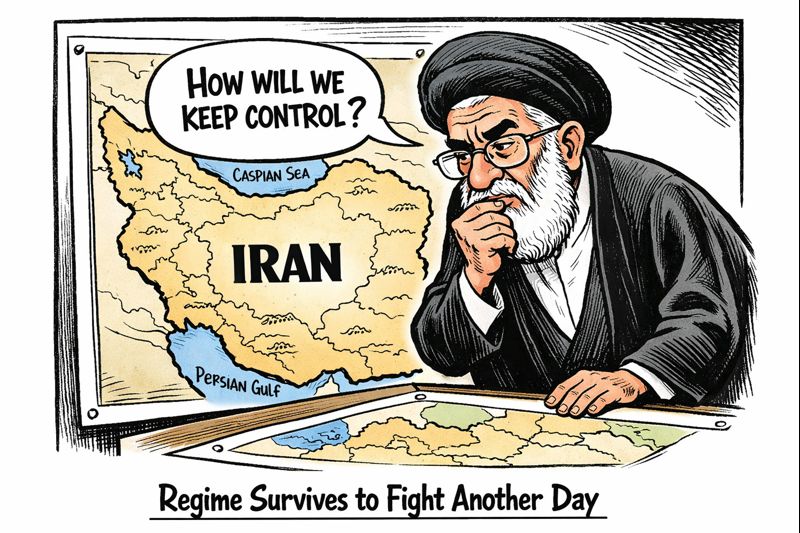
Reform may come from who leads Iran next. With the Supreme Leader Ayatollah Ali Khamenei, now aged 86-years, in control after 36-years of being the Islamic spiritual and effectively political leader of Iran, many claim his age alone will help resolve the change in leadership when he appoints his replacement. Often derided as “old”, “feeble” and “out of touch”. By contrast, he is only 6-years older than the increasingly health-challenged Donald Trump whose grip on the White House and world affairs has shown him to be robust in executing his policies across the globe, most recently in the Middle East and Venezuela. Without Ayatollah Ali Khamenei ceding power willingly to an heir-apparent, even then most likely picking a success of like temperament, views and policies, Iranians have little hope of domestic reform that might moderate their discontent with continuing with the Islamic Republic’s policies at home and abroad. Still, as there appears to be an absence of consensus on an external candidate to unit Iranians, it remains up to the regime to either double-down on the use of force and violence to keep an imperiled Iran together or seek sufficient reforms to quell public unrest.
One thing is certain, however. Having pinned their hope on Trump’s encouragement to keep protesting and that “help is on its way”, when push came to shove, Trump threw-up his hands and said he is satisfied with the Islamic Republic’s response to the protests and supposed pledge not to engage in enacting capital punishment upon protestors. For now, it seems like a return to the status quo with Iranians increasingly unhappy and the regime equally failing to meet the basic needs and provide hope to its populace. Until things change, the best the Islamic Republic of Iran can hope for at the moment is to survive to fight another day – a tiresome prospect for all.